Animals / Mammal
Nine-banded armadillo
Dasypus novemcinctus · Dasypodidae
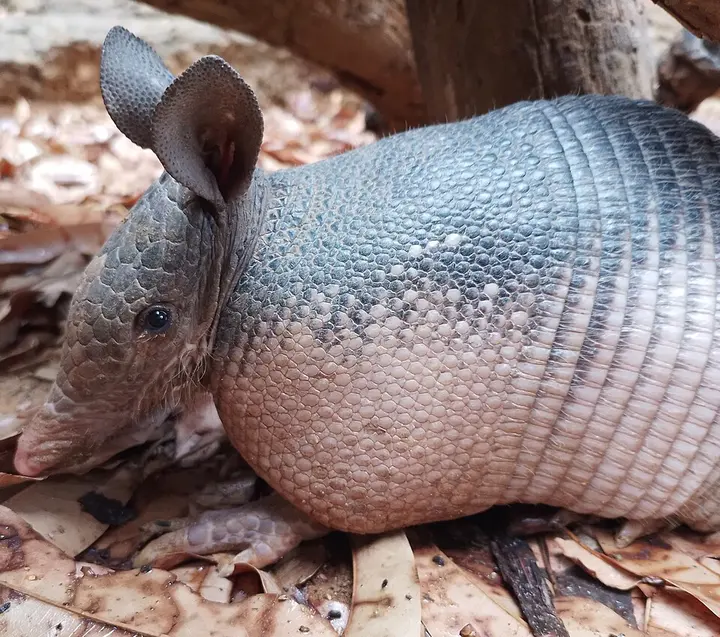
The nine-banded armadillo, also called the nine-banded long-nosed armadillo or common armadillo, is a species of armadillo native to South America. The Mexican long-nosed armadillo of North America was formerly treated as a subspecies of the nine-banded armadillo.
The nine-banded armadillo is a solitary, mainly nocturnal animal, found in many kinds of habitats, from mature and secondary rainforests to grassland and dry scrub. It is an insectivore, feeding chiefly on ants, termites, and other small invertebrates. The armadillo can jump 91–120 cm (3–4 ft) straight in the air if sufficiently frightened, making it a particular danger on roads.
Appearance
Nine-banded armadillos generally weigh from 2.5–6.5 kg (5.5–14.3 lb), though the largest specimens can scale up to 10 kg (22 lb). They are one of the largest species of armadillos. Head and body length is 38–58 cm (15–23 in), which combines with the 26–53 cm (10–21 in) tail, for a total length of 64–107 cm (25–42 in). They stand 15–25 cm (5.9–9.8 in) tall at the top of the shell.
Behaviour
Nine-banded armadillos are solitary, largely nocturnal animals that come out to forage around dusk. They are extensive burrowers, with a single animal sometimes maintaining up to 12 burrows on its range. These burrows are roughly 20 cm (8 in) wide, 210 cm (7 ft) deep, and 760 cm (25 ft) long. Armadillos mark their territory with urine, feces, and excretions from scent glands found on the eyelids, nose, and feet.
Diet
Nine-banded armadillos are generally insectivores. They forage for meals by thrusting their snouts into loose soil and leaf litter and frantically digging in erratic patterns, stopping occasionally to dig up grubs, beetles (perhaps the main portion of this species' prey selection), ants, termites, grasshoppers, other insects, millipedes, centipedes, arachnids, worms, and other terrestrial invertebrates, which their sensitive noses can detect through 8 in (20 cm) of soil.
Habitat
The nine-banded armadillo evolved in a warm, rainy environment, and is still most commonly found in regions resembling its ancestral home. As a very adaptable animal, though, it can also be found in scrublands, open prairies, and tropical rainforests. It cannot thrive in particularly cold or dry environments, as its large surface area, which is not well insulated by fat, makes it especially susceptible to heat and water loss.
Life cycle
Mating takes place during a two-to-three month long mating season, which occurs from November–January. A single egg is fertilized and develops into a blastocyst, but implantation is delayed for three to four months to ensure the young will not be born during an unfavorable time. Once the blastocyst does implant in the uterus it splits into four identical embryos via collapse of the common amnion and subsequent division of the embryonic shield.
Where the Nine-banded armadillo lives
Recorded in Colombia, Brazil, Ecuador, United States of America, Uruguay, Costa Rica and Mexico (South America and North America).
Most records fall in Meta, Santander, Casanare, Paraná, Sucumbios and Rio de Janeiro.
See the Nine-banded armadillo’s range on the globe
Conservation status
Least concern (LC). Not at risk: it is doing well in the wild. Categories are the IUCN Red List as republished by GBIF.
Sources
The range is a density of 29,770 georeferenced GBIF records, shown on the continents where it is mainly recorded, not an expert-drawn map. Description from Wikipedia.