Animals / Reptile
Nile crocodile
Crocodylus niloticus · Crocodylidae
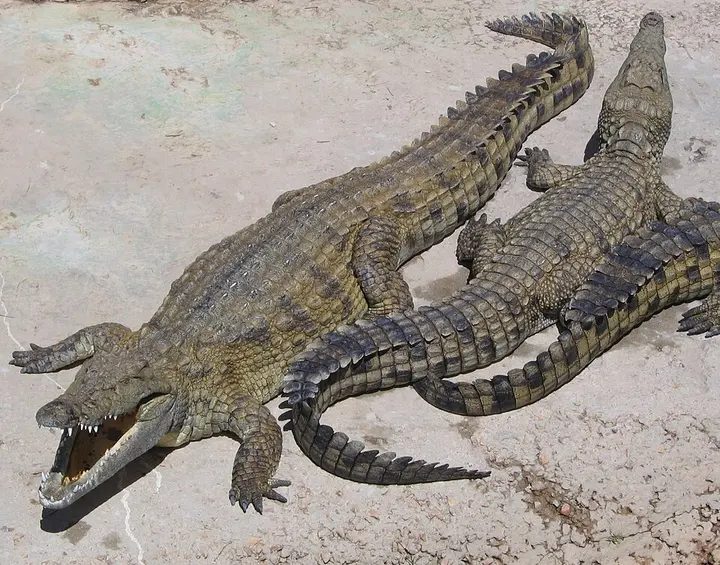
The Nile crocodile is a large crocodilian native to freshwater habitats in Africa, where it is present in 26 countries. It is widely distributed in sub-Saharan Africa, occurring mostly in the eastern, southern, and central regions of the continent, and lives in different types of aquatic environments such as lakes, rivers, swamps and marshlands. It occasionally inhabits deltas, brackish lakes and rarely also saltwater.
Its range once stretched from the Nile Delta throughout the Nile River. Lake Turkana in Kenya has one of the largest undisturbed Nile crocodile populations. Generally, the adult male Nile crocodile is between 3.5 and 5 m (11 ft 6 in and 16 ft 5 in) in length and weighs 225 to 750 kg (496 to 1,653 lb). However, specimens exceeding 6.1 m (20 ft) in length and 1,000 kg (2,200 lb) in weight have been recorded. It is the largest predator in Africa, and may be considered the second-largest extant reptile in the world, after the saltwater crocodile (Crocodylus porosus). Size is sexually dimorphic, with females usually about 30% smaller than males. The crocodile has thick, scaly, heavily armoured skin.
Appearance
The Nile crocodile is the largest crocodilian in Africa, and is generally considered the second-largest crocodilian after the saltwater crocodile. Typical size has been reported to be as much as 4.5 to 5.5 m (14 ft 9 in to 18 ft 1 in), but this is excessive for actual average size per most studies and represents the upper limit of sizes attained by the largest animals in a majority of populations.
Behaviour
Generally, Nile crocodiles are relatively inert creatures, as are most crocodilians and other large, cold-blooded creatures. More than half of the crocodiles observed by Cott (1961), if not disturbed, spent the hours from 9:00 a.m. to 4:00 p.m. continuously basking with their jaws open if conditions were sunny. If their jaws are bound together in the extreme midday heat, Nile crocodiles may easily die from overheating.
Habitat
The Nile crocodile's current distribution extends from the regional tributaries of the Nile in Sudan and Lake Nasser in Egypt to the Cunene River in Angola, the Okavango Delta of Botswana, and the Olifants River in South Africa.
Life cycle
On average, sexual maturity is obtained from 12 to 16 years of age. For males, the onset of sexual maturity occurs when they are about 3.3 m (10 ft 10 in) long and mass of 155 kg (342 lb), being fairly consistent. On the other hand, that for females is rather more variable, and may be indicative of the health of a regional population based on size at sexual maturity.
Where the Nile crocodile lives
Recorded in South Africa, Kenya, Botswana, Tanzania, Zambia, Uganda, Namibia, Zimbabwe and Malawi (Africa).
Most records fall in Mpumalanga, North-West, Limpopo, KwaZulu-Natal, Rift Valley and Mara.
See the Nile crocodile’s range on the globe
Conservation status
Least concern (LC). Not at risk: it is doing well in the wild. Categories are the IUCN Red List as republished by GBIF.
Sources
The range is a density of 10,411 georeferenced GBIF records, shown on the continents where it is mainly recorded, not an expert-drawn map. Description from Wikipedia.