Animals / Mammal
Narwhal
Monodon monoceros · Monodontidae
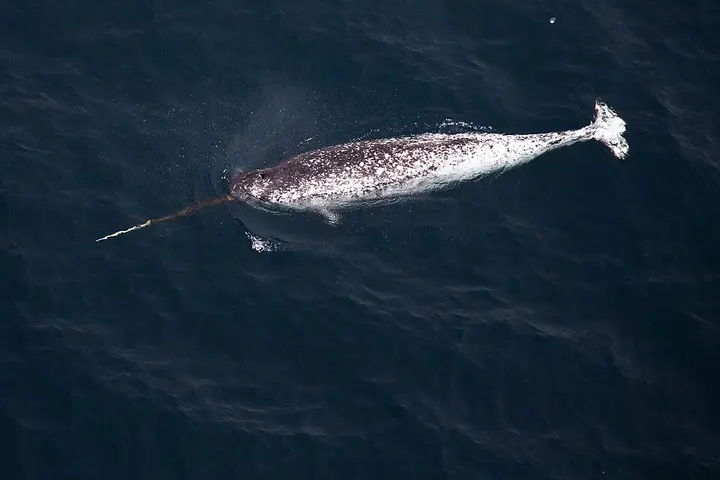
The narwhal is a species of toothed whale native to the Arctic. It is the only member of the genus Monodon and one of two living representatives of the family Monodontidae. The narwhal is a stocky cetacean with a relatively blunt snout, a large melon, and a shallow ridge in place of a dorsal fin.
Males of this species have a spiralled tusk, which is a protruding left canine, that is 1.5–3.0 m (4.9–9.8 ft) long and thought to function as a secondary sexual characteristic, a weapon, a tool for feeding, or a sensory organ. Specially adapted slow-twitch muscles, along with the jointed neck vertebrae and shallow dorsal ridge allow for easy movement through the Arctic environment, where the narwhal spends extended periods at great depths. The narwhal's geographic range overlaps with that of the similarly built and closely related beluga whale, and the animals are known to interbreed. Narwhals inhabit the Arctic waters of Canada, Greenland and Russia. Every year, they migrate to ice-free summering grounds, usually in shallow waters, and often return to the same sites in subsequent years.
Appearance
The narwhal has a robust body with a short, blunt snout, small upcurved flippers, and convex to concave tail flukes. Adults measure 3.0 to 5.5 m (9.8 to 18.0 ft) in length and weigh 800 to 1,600 kg (1,800 to 3,500 lb). Male narwhals attain sexual maturity at 12 to 20 years of age, reaching a length of 3.5 to 4.0 m (11.5 to 13.1 ft). Females reach sexual maturity at a younger age, between 8 and 9 years old, when they are about 3.4 m (11 ft) long.
Behaviour
Narwhals normally congregate in groups of three to eight individuals. Groups may be "nurseries" with only females and young, or can contain only juveniles or adult males ("bulls"); mixed groups can occur at any time of year. In the summer, several groups come together, forming larger aggregations which can contain 500 to over 1,000 individuals. Male narwhals have been observed rubbing each other's tusks, a behaviour known as "tusking".
Diet
Narwhals have a restricted and specialised diet. Due to the lack of well-developed dentition, narwhals are believed to feed by swimming close to prey and sucking them into the mouth. A study of the stomach contents of 73 narwhals found Arctic cod (Boreogadus saida) to be the most commonly consumed prey, followed by Greenland halibut (Reinhardtius hippoglossoides). Large quantities of Boreo-Atlantic armhook squid (Gonatus fabricii) were also discovered.
Habitat
The narwhal is found in the Atlantic and Russian areas of the Arctic Ocean. Individuals are commonly recorded in the Canadian Arctic Archipelago, such as in the northern part of Hudson Bay, in Hudson Strait, in Baffin Bay, off the east coast of Greenland and in a strip running east from the northern end of Greenland to eastern Russia (170° east). Land in this strip includes Svalbard, Franz Joseph Land and Severnaya Zemlya.
Where the Narwhal lives
Recorded in Canada, Greenland and United States of America (North America).
Most records fall in Nunavut, Qaasuitsup Kommunia, Nationalparken, Kommuneqarfik Sermersooq, Alaska and Qeqqata Kommunia.
See the Narwhal’s range on the globe
Conservation status
Least concern (LC). Not at risk: it is doing well in the wild. Categories are the IUCN Red List as republished by GBIF.
Sources
The range is a density of 314 georeferenced GBIF records, shown on the continents where it is mainly recorded, not an expert-drawn map. Description from Wikipedia.