Animals / Bird
Mute swan
Cygnus olor · Anatidae
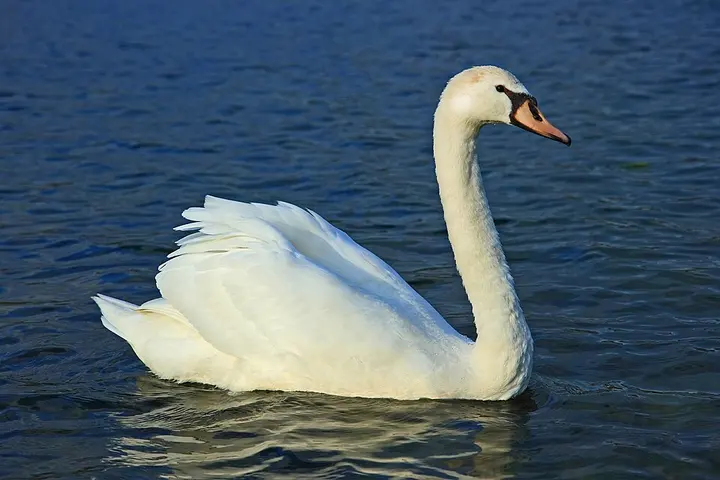
The mute swan is a species of swan and a member of the family Anatidae within the waterfowl order. It is native to much of Europe and parts of Asia and the far north of Africa. It is an introduced species in North America, home to the largest populations outside of its native range, with additional smaller introductions in Australasia and Southern Africa.
The name "mute" derives from it being less vocal than other swan species. Typically measuring 140 to 160 cm (55 to 63 in) in length, this large swan is wholly white in plumage, with an orange beak bordered with black. It is recognisable by its pronounced knob atop the beak, which is larger in males.
Appearance
Adults of this large swan typically range from 140 to 160 cm (55 to 63 in) long, although they can range in extreme cases from 125 to 170 cm (49 to 67 in), with a 200 to 240 cm (79 to 94 in) wingspan. Males are larger than females and have a larger knob on their bill. On average, this is the second largest waterfowl species after the trumpeter swan, although male mute swans can easily match or even exceed a male trumpeter in mass.
Behaviour
Unlike black swans, mute swans are usually strongly territorial, with just a single pair on smaller lakes, though in a few locations where a large area of suitable feeding habitat is found, they can be colonial. The largest colonies have over 100 pairs, such as at the colony at Abbotsbury Swannery in Southern England and at the southern tip of Öland, Ottenby Preserve, in the coastal waters of the Baltic Sea; they can have nests spaced as little as 2 m (7 ft) apart.
Diet
They feed on a wide range of vegetation, both by reaching submerged aquatic plants with their long necks and by grazing on land. The food commonly includes agricultural crop plants such as oilseed rape and wheat, and in winter, feeding flocks may cause significant crop damage — often as much through trampling with their large webbed feet as through direct consumption. Mute swans also feed on small proportions of aquatic insects, fish, and frogs.
Habitat
The mute swan is found naturally mainly in temperate areas of Europe and across the Palearctic, as far east as Primorsky Krai, near Sidemi.
Life cycle
Mute swans nest on large mounds that they build with waterside vegetation in shallow water on islands in the middle or at the very edge of a lake. They are monogamous and often reuse the same nest each year, restoring or rebuilding it as needed. Male and female swans share the care of the nest, and once the cygnets are fledged, it is not uncommon to see whole families looking for food.
Where the Mute swan lives
Recorded in Sweden, Netherlands, United Kingdom, Denmark, Norway, France, Germany and Belgium (North America and Europe).
Introduced, not native, in United States of America and Canada.
Most records fall in Ontario, New York, Michigan, Massachusetts, New Jersey and Hovedstaden.
See the Mute swan’s range on the globe
Conservation status
Least concern (LC). Not at risk: it is doing well in the wild. Categories are the IUCN Red List as republished by GBIF.
Sources
The range is a density of 6,773,683 georeferenced GBIF records, shown on the continents where it is mainly recorded, not an expert-drawn map. Description from Wikipedia.