Animals / Mammal
Muskox
Ovibos moschatus · Bovidae
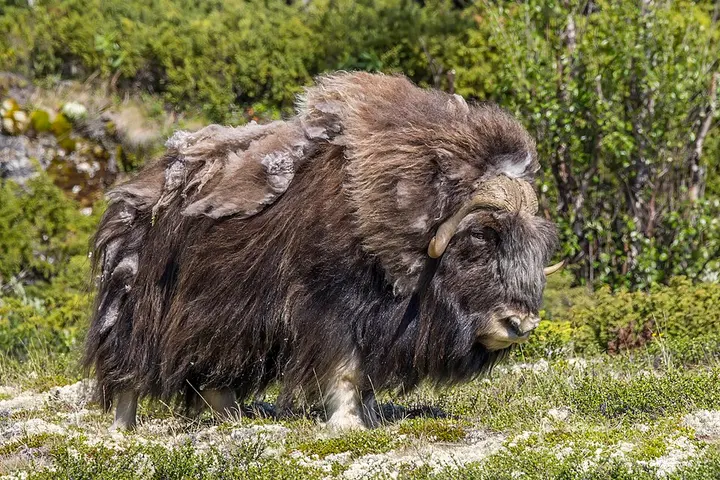
The muskox is a hoofed mammal of the family Bovidae. Native to the Arctic, it is noted for its thick coat and for the strong odor emitted by males during the seasonal rut, from which its name derives. This musky odor has the effect of attracting females during mating season.
Its Inuktitut name umingmak translates to "the bearded one". Its Woods Cree names mâthi-môs and mâthi-mostos translate to "ugly moose" and "ugly bison", respectively. Muskoxen are found primarily in Greenland, the Canadian Arctic of the Northwest Territories and Nunavut, as well as Alaska. They were formerly present in Eurasia, with their youngest natural records in the region dating to around 2,700 years ago. There are reintroduced populations in the U.S. state of Alaska, the Canadian territory of Yukon, and Siberia, and an introduced population in Norway, part of which emigrated to Sweden, where a small population now lives.
Appearance
Both male and female muskoxen have long, curved horns. Muskoxen stand 1.1 to 1.5 m (3 ft 7 in to 4 ft 11 in) high at the withers, with females measuring 135 to 200 cm (4 ft 5 in to 6 ft 7 in) in length, and the larger males 200 to 250 cm (6 ft 7 in to 8 ft 2 in). The small tail, often concealed under a layer of fur, measures only 10 cm (3.9 in) long. Adults, on average, weigh 285 kg (628 lb), but can range from 180 to 410 kg (400 to 900 lb).
Behaviour
During the summer, muskoxen live in wet areas, such as river valleys, moving to higher elevations in the winter to avoid deep snow. Muskoxen will eat grasses, arctic willows, woody plants, lichens and mosses. When food is abundant, they prefer succulent and nutritious grasses in an area. Willows are the most commonly eaten plants in the winter. Muskoxen require a high threshold of fat reserves in order to conceive, which reflects their conservative breeding strategy.
Habitat
During the Pleistocene period, muskoxen were much more widespread. Fossil evidence shows that they were widespread across the Siberian and North American Arctic, from the Urals to Greenland. The ancestors of today's muskoxen came across the Bering Land Bridge to North America between 200,000 and 90,000 years ago.
Where the Muskox lives
Recorded in Norway, United States of America, Greenland and Canada (Europe and North America).
Most records fall in Sør-Trøndelag, Oppland, Alaska, Nunavut, Nationalparken and Møre og Romsdal.
See the Muskox’s range on the globe
Conservation status
Least concern (LC). Not at risk: it is doing well in the wild. Categories are the IUCN Red List as republished by GBIF.
Sources
The range is a density of 10,488 georeferenced GBIF records, shown on the continents where it is mainly recorded, not an expert-drawn map. Description from Wikipedia.