Animals / Bird
Mourning dove
Zenaida macroura · Columbidae
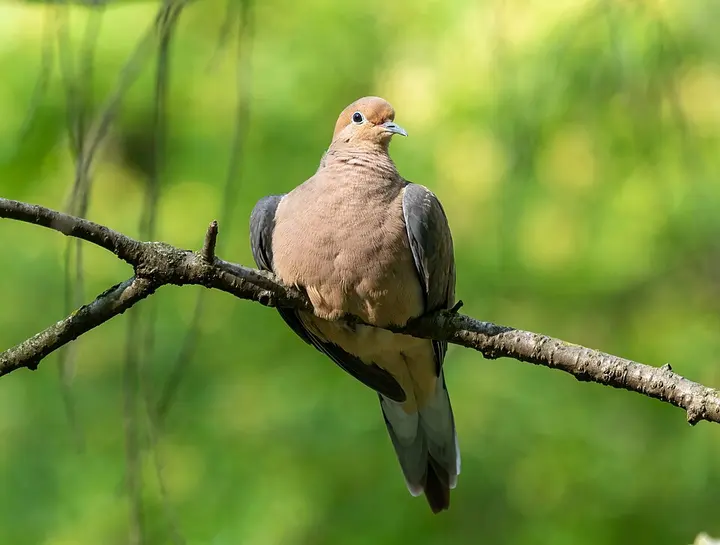
The mourning dove is a member of the dove family, Columbidae. The bird is also known as the American mourning dove, the rain dove, and colloquially as the turtle dove, and it was once known as the Carolina pigeon and Carolina turtledove. It is one of the most abundant and widespread North American birds and a popular gamebird, with more than 20 million birds shot annually in the U.S., both for sport and meat.
Its ability to sustain its population under such pressure is due to its prolific breeding; in warm areas, one pair may raise up to six broods of two young each in a single year. The wings make an unusual whistling sound upon take-off and landing, a form of sonation. The bird is a strong flier, capable of speeds up to 88 km/h (55 mph). Mourning doves are light gray and brown and generally muted in color. Males and females are similar in appearance. The species is generally monogamous, with two squabs (young) per brood. Both parents incubate and care for the young. Mourning doves eat almost exclusively seeds, but the young are fed crop milk by their parents.
Appearance
The mourning dove is a medium-sized, slender dove approximately 31 cm (12 in) in length. Mourning doves weigh 112–170 g (4.0–6.0 oz), usually closer to 128 g (4.5 oz). The mourning dove has a wingspan of 37–45 cm. The elliptical wings are broad, and the head is rounded. Its tail is long and tapered ("macroura" comes from the Greek words for "large" and "tail"). Mourning doves have perching feet, with three toes forward and one reversed.
Behaviour
This species' call is a distinctive, plaintive cooOOoo-wooo-woo-woooo, uttered by males to attract females, and it may be mistaken for the call of an owl at first. During the call, the throat of the dove swells. Close up, a grating or throat-rattling sound may be heard preceding the first coo.
Diet
Mourning doves eat almost exclusively seeds, which make up more than 99% of their diet. Rarely, they will eat snails or insects. Mourning doves generally eat enough to fill their crops and then fly away to digest while resting. They often swallow grit such as fine gravel or sand to assist with digestion. The species usually forages on the ground, walking but not hopping.
Habitat
The mourning dove has a large range of nearly 11,000,000 km2 (4,200,000 sq mi). The species is resident throughout the Greater Antilles, most of Mexico, the Continental United States, southern Canada, and the Atlantic archipelago of Bermuda. Much of the Canadian prairie sees these birds in summer only, and southern Central America sees them in winter only. The species is a vagrant in northern Canada, Alaska, and South America.
Where the Mourning dove lives
Recorded in United States of America and Canada (North America).
Most records fall in California, New York, Texas, Florida, Pennsylvania and Ontario.
See the Mourning dove’s range on the globe
Conservation status
Least concern (LC). Not at risk: it is doing well in the wild. Categories are the IUCN Red List as republished by GBIF.
Sources
The range is a density of 27,353,209 georeferenced GBIF records, shown on the continents where it is mainly recorded, not an expert-drawn map. Description from Wikipedia.