Animals / Mammal
Mountain hare
Lepus timidus · Leporidae
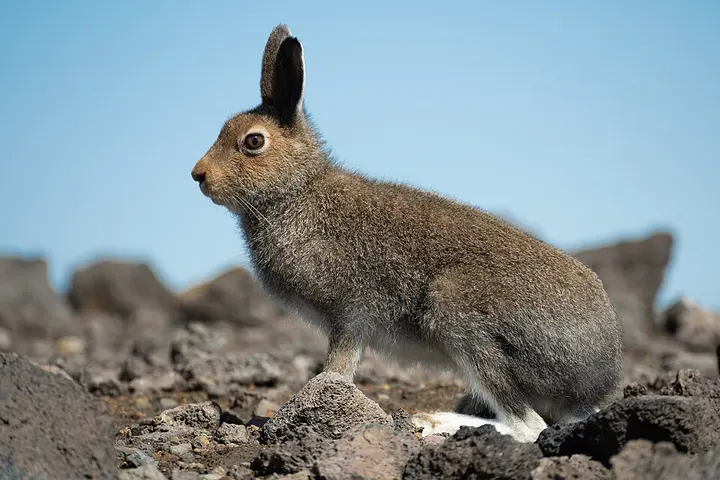
The mountain hare or arctic hare, also known as blue hare, tundra hare, variable hare, white hare, snow hare, alpine hare, and Irish hare, is a species of hare that is largely adapted to polar and mountainous habitats in the Palearctic realm. It is a large hare, slightly smaller than the European hare and identifiable by its tail, which is completely white throughout the year. Mountain hares have a brown coat in summer and white to grey in winter.
Their diet is highly adaptive to their environment, but is generally made up of plant matter such as grass, twigs, and bark.
Appearance
The mountain hare is a large species, though it is slightly smaller than the European hare. It grows to a length of 45–65 cm (18–26 in), with a tail of 4–8 cm (1+1⁄2–3 in), and a mass of 2–5.3 kg (4+1⁄2–11+3⁄4 lb), females being slightly heavier than males. They can live for up to 12 years. In summer, for all populations of mountain hares, the coat is various shades of brown. In preparation for winter most populations moult into a white (or largely white) pelage.
Behaviour
The diet of the mountain hare varies from region to region, though it tends to prefer plants with high nutrient content growing in fertilized soil. Clover and grasses are preferred across much of the hare's distribution, but when snow cover restricts food availability, bark, moss, lichens and twigs many be consumed. In forested habitats, the hare eats the leaves and wood of deciduous plants, including willow, ash, birch, cottonwood, and juniper.
Habitat
The mountain hare is found within the Palearctic realm, distributed from Fennoscandia to eastern Siberia; in addition, isolated populations occur in the Alps, Scotland, the Baltics, northeastern Poland, the Kuril Islands, as well as on Sakhalin and Hokkaidō islands. In Ireland, the Irish hare (L. t. hibernicus) lives on lowland pastures, coastal grasslands, and Salt marshes, not just in the mountains.
Where the Mountain hare lives
Recorded in Norway, France, Sweden, Switzerland, United Kingdom, Ireland, Finland and Russia (Europe).
Most records fall in Hautes-Alpes, Norrbotten, Graubünden, Sør-Trøndelag, Nordland and Lapland.
See the Mountain hare’s range on the globe
Conservation status
Least concern (LC). Not at risk: it is doing well in the wild. Categories are the IUCN Red List as republished by GBIF.
Sources
The range is a density of 99,004 georeferenced GBIF records, shown on the continents where it is mainly recorded, not an expert-drawn map. Description from Wikipedia.