Animals / Mammal
Mountain gorilla
Gorilla beringei · Hominidae
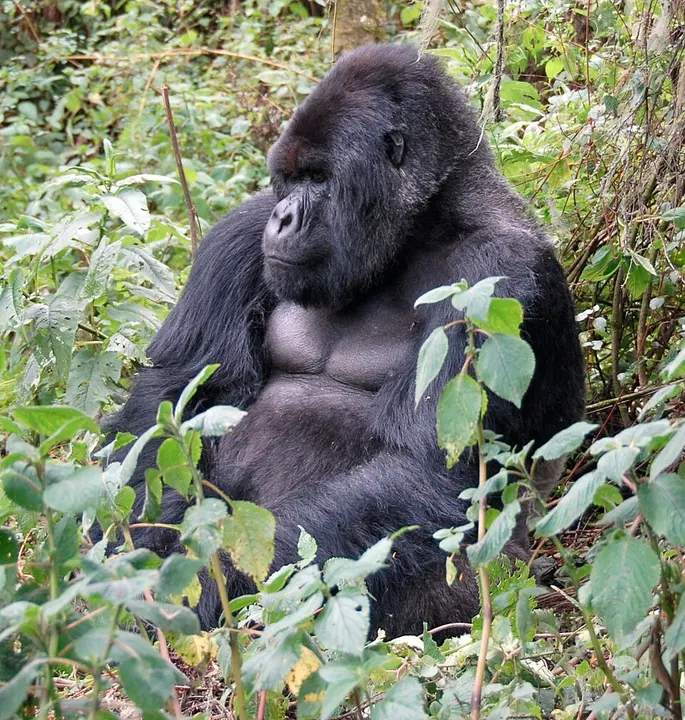
The mountain gorilla is one of the two subspecies of the eastern gorilla. It is listed as endangered by the IUCN as of 2018.
There are two populations: One lives in the Virunga Mountains in Mgahinga in southwestern Uganda, Volcanoes in northwestern Rwanda and Virunga National Park in the eastern Democratic Republic of Congo. The other population lives in Uganda's Bwindi Impenetrable National Park. Some primatologists speculate the Bwindi population is a separate subspecies. As of 2019, there are an estimated 1,063 mountain gorillas in the world.
Appearance
The fur of the mountain gorilla, often thicker and longer than that of other gorilla species, enables them to live in colder temperatures. Gorillas can be identified by nose prints unique to each individual. Males reach a standing height of 1.61–1.71 m (5.3–5.6 ft), a girth of 1.38–1.63 m (4.5–5.3 ft), an arm span of 2 to 2.7 m (6.6 to 8.9 ft) and a weight of 120–191 kg (265–421 lb). Females are smaller with a weight of 70–98 kg (154–216 lb).
Behaviour
The home range used by one group of gorillas during one year is influenced by availability of food sources and usually includes several vegetation zones. George Schaller identified ten distinct zones, including: bamboo forest at 2,200–2,800 m (7,200–9,200 ft); Hagenia forest at 2,800–3,400 m (9,200–11,200 ft); and the giant senecio zone at 3,400–4,300 m (11,200–14,100 ft).
Diet
The mountain gorilla is primarily a herbivore; the majority of its diet is composed of the leaves, shoots, stems, and pith (85.8%) of 142 plant species. It also feeds on bark and wood (6.9%), roots and their epithelium (3.3%), flowers (2.3%), and fruit (1.7%), as well as insects, fungi, galls, and gorilla dung (0.1%). In a year long study in Bwindi Impenetrable Forest adult males ate an average of 18.8 kg (41 lb) of food a day, while females ate 14.9 kg (33 lb).
Habitat
The mountain gorilla inhabits the Albertine Rift montane cloud forest, including the Virunga Mountains, ranging in elevation from 2,200 to 4,300 m (7,200 to 14,100 ft). Most groups live on the slopes of three of the dormant volcanoes: Karisimbi, Mikeno, and Visoke. The vegetation is very dense at the bottom of the mountains, becoming more sparse at higher elevations, and the forests are often cloudy, misty and cold.
Where the Mountain gorilla lives
Recorded in Uganda, Rwanda and Dem. Rep. Congo (Africa).
Most records fall in Kisoro, Kanungu, Northern, Western, Kabale and Nord-Kivu.
See the Mountain gorilla’s range on the globe
Conservation status
Endangered (EN). In danger of dying out in the wild. Categories are the IUCN Red List as republished by GBIF.
Sources
The range is a density of 946 georeferenced GBIF records, shown on the continents where it is mainly recorded, not an expert-drawn map. Description from Wikipedia.