Animals / Mammal
Mountain goat
Oreamnos americanus · Bovidae
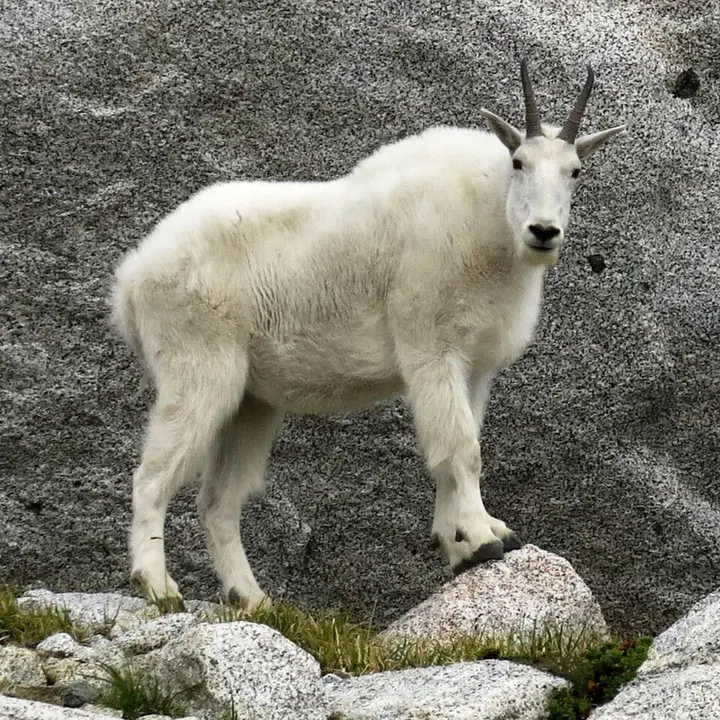
The mountain goat, also known as the Rocky Mountain goat, is a cloven-footed mammal that is endemic to the remote and rugged mountainous areas of western North America. A subalpine to truly alpine species, it is a sure-footed climber commonly seen on sheer rock faces, near-vertical cliffs and icy passages. Mountain goats generally avoid venturing down into lower elevations—except during seasonal food shortages or during particularly bad weather—as the extreme elevation of their habitat is the primary defense against predators such as black and brown bears, pumas and wolves.
Despite its vernacular name and both genera being in the same subfamily (Caprinae), the mountain goat is not a member of Capra, the genus that includes all true goats (such as the wild goat (Capra aegagrus), from which the domestic goat is derived); rather, it is more closely allied with the other bovids known as "goat-antelopes", including the European chamois (Rupicapra), the gorals (Naemorhedus), the takins (Budorcas) and the serows (Capricornis), of Japan and eastern South Asia.
Diet
Mountain goats are herbivores and spend most of their time grazing. Their diets include grasses, herbs, sedges, ferns, mosses, lichens, and twigs and leaves from the low-growing shrubs and conifers of their high-altitude habitat. In captivity, the mountain goat's diet can also include grain, alfalfa, fruits, vegetables and grass.
Where the Mountain goat lives
Recorded in United States of America and Canada (North America).
Most records fall in Alaska, Montana, Washington, Colorado, British Columbia and Alberta.
See the Mountain goat’s range on the globe
Conservation status
Least concern (LC). Not at risk: it is doing well in the wild. Categories are the IUCN Red List as republished by GBIF.
Sources
The range is a density of 9,094 georeferenced GBIF records, shown on the continents where it is mainly recorded, not an expert-drawn map. Description from Wikipedia.