Animals / Mammal
Moose
Alces alces · Cervidae
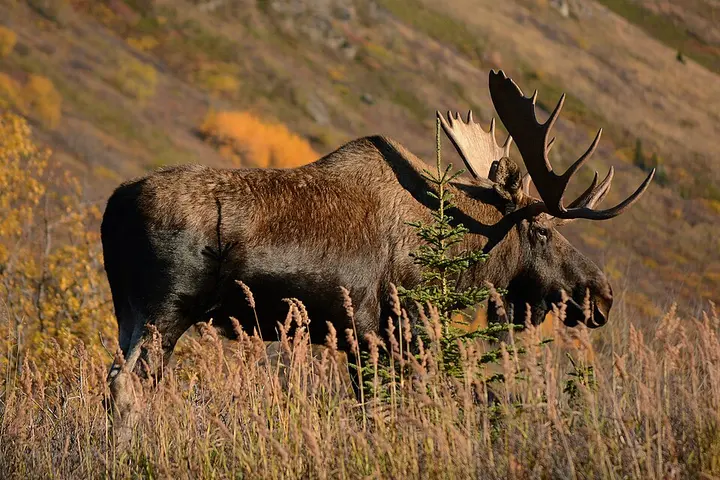
The moose or elk is the world's tallest, largest and heaviest extant species of deer and the only extant species in the genus Alces. It is also the tallest, and the second-largest, land animal in North America, falling short only to the American bison in body mass. Most adult male moose have broad, palmate antlers; other members of the deer family have pointed antlers with a dendritic ("twig-like") configuration.
Moose inhabit the circumpolar boreal forests or temperate broadleaf and mixed forests of the Northern Hemisphere, thriving in cooler, temperate areas as well as subarctic climates. Hunting shaped the relationship between moose and humans, both in Eurasia and North America. Prior to the early modern period (around 1600–1700), moose were one of many valuable sources of sustenance for certain North American Indians. Hunting and habitat loss have reduced the moose's range; this fragmentation has led to sightings of "urban moose" in some areas. The moose has been reintroduced to some of its former habitats. Currently, the greatest populations occur in Canada.
Appearance
On average, an adult moose stands 1.4–2.1 m (4.6–6.9 ft) high at the shoulder, which is more than 30 cm (1 ft) higher than the next-largest deer on average, the wapiti. The tail is short (6–8 cm (2.4–3.1 in) in length) and vestigial in appearance; unlike other ungulates the moose tail is too short to swish away insects.
Diet
The moose is a browsing herbivore and is capable of consuming many types of plant or fruit. The average adult moose needs to consume 96 megajoules (23,000 kilocalories) per day to maintain its body weight. Much of a moose's energy is derived from terrestrial vegetation, mainly consisting of forbs and other non-grasses, and fresh shoots from trees such as willow and birch.
Habitat
Moose require habitat with adequate edible plants (e.g., pond grasses, young trees and shrubs), cover from predators, and protection from extremely hot or cold weather. Moose travel among different habitats with the seasons to address these requirements. Moose are cold-adapted mammals with thickened skin, dense, heat-retaining coat, and a low surface-to-volume ratio, which provides excellent cold tolerance but poor heat tolerance.
Where the Moose lives
Recorded in Estonia, Norway, Sweden, United States of America, Canada, Russia, Poland and Finland (Europe and North America).
Most records fall in Alaska, Nordland, Pärnu, Viljandi, Ontario and Colorado.
See the Moose’s range on the globe
Conservation status
Least concern (LC). Not at risk: it is doing well in the wild. Categories are the IUCN Red List as republished by GBIF.
Sources
The range is a density of 143,016 georeferenced GBIF records, shown on the continents where it is mainly recorded, not an expert-drawn map. Description from Wikipedia.