Animals / Jellyfish
Moon jellyfish
Aurelia aurita · Ulmaridae
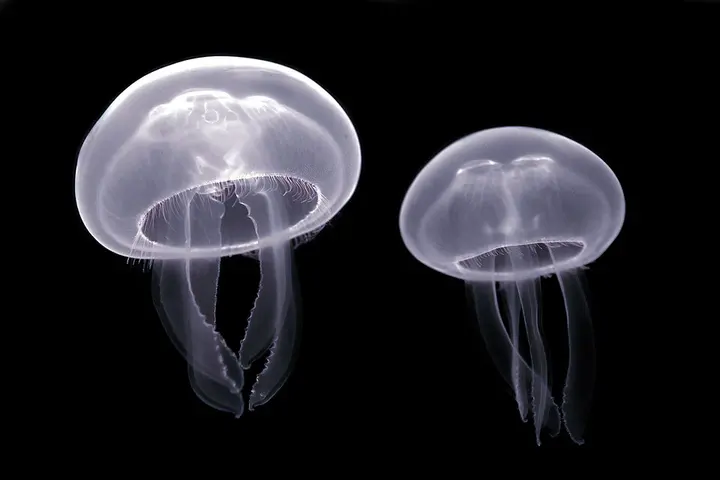
Aurelia aurita is a species of true jellyfish in the family Ulmaridae and the type species of its genus, Aurelia. Before the 2020s, the species was considered cosmopolitan, but the taxon has since been split into at least 28 species. The species now identified as A. aurita is only found in the north Atlantic and in Argentina and is not dangerous to humans.
Appearance
Like other species in the genus, the jellyfish is almost entirely translucent, usually about 25–40 cm (10–16 in) in diameter, and can be recognized by its four horseshoe-shaped gonads, easily seen through the top of the bell. It feeds by collecting medusae, plankton, copepods, mollusks, and fish eggs with its short, fine tentacles, and bringing them into its body for digestion. The sting has a mild effect on humans, with most having little or no reaction.
Habitat
A. aurita is endemic to the northeastern Atlantic Ocean, including the Baltic Sea where the 1758 type specimen was collected. Established populations are also found in the Northeastern United States and Argentina, where they were introduced (although natural dispersion to the United States can't be ruled out). A single specimen has also been found in the Pacific Northwest.
Life cycle
The life cycle of Aurelia aurita is similar to other species in the genus, consisting of two main stages: the free-swimming medusa and the benthic polyp, also known as a scyphistoma. During the medusa stage, A. aurita reproduces sexually, as opposed to the asexually reproducing polyp stage. The scyphistoma stage can survive for months without feeding, and have been shown to have relatively low feeding selectivity.
Where the Moon jellyfish lives
Recorded in Netherlands, Norway, United Kingdom, Sweden, Germany, United States of America, Ireland, Poland, Ukraine, Finland and Denmark (Europe and North America).
Most records fall in Noord-Holland, Zeeland, Zuid-Holland, Friesland, Vestfold and Texas.
See the Moon jellyfish’s range on the globe
Conservation status
Not evaluated (NE). Scientists haven’t checked yet how at risk it is, so this doesn’t mean it is safe or in danger. Categories are the IUCN Red List as republished by GBIF.
Sources
The range is a density of 33,559 georeferenced GBIF records, shown on the continents where it is mainly recorded, not an expert-drawn map. Description from Wikipedia.