Animals / Mammal
Meerkat
Suricata suricatta · Herpestidae
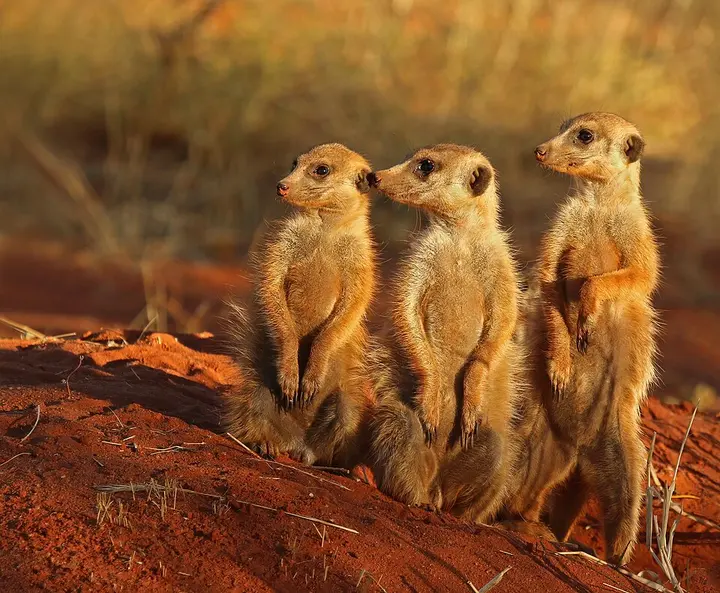
The meerkat or suricate is a small mongoose found in southern Africa. It is characterised by a broad head, large eyes, a pointed snout, long legs, a thin tapering tail, and a brindled coat pattern. The head-and-body length is around 24–35 cm (9.4–13.8 in), and the weight is typically between 0.62 and 0.97 kg.
The coat is light grey to yellowish-brown with alternate, poorly defined light and dark bands on the back. Meerkats have foreclaws adapted for digging and have the ability to thermoregulate to survive in their harsh, dry habitat. Three subspecies are recognised. Meerkats are highly social, and form packs of two to 30 individuals each that occupy home ranges around 5 km2 (1.9 sq mi) in area. There is a social hierarchy—generally dominant individuals in a pack breed and produce offspring, and the nonbreeding, subordinate members provide altruistic care to the pups. Breeding occurs around the year, with peaks during heavy rainfall; after a gestation of 60 to 70 days, a litter of three to seven pups is born.
Appearance
The meerkat is a small mongoose of slim build characterised by a broad head, large eyes, a pointed snout, long legs, a thin tapering tail, and a brindled coat pattern. It is smaller than most other mongooses except the dwarf mongooses (genus Helogale) and possibly Galerella species.
Behaviour
The meerkat is a social mammal, forming packs of two to 30 individuals each comprising nearly equal numbers of either sex and multiple family units of pairs and their offspring. Members of a pack take turns at jobs such as looking after pups and keeping a lookout for predators. Meerkats are a cooperatively breeding species—typically the dominant 'breeders' in a pack produce offspring. The nonbreeding, subordinate 'helpers' provide altruistic care for the pups.
Diet
The meerkat is primarily an insectivore, feeding heavily on beetles and lepidopterans; it can additionally feed on eggs, amphibians, arthropods (such as scorpions, to whose venom they are immune), reptiles, small birds (such as the southern anteater-chat), plants and seeds. Captive meerkats include plenty of fruits and vegetables in their diet, and also kill small mammals by biting the backs of their skulls.
Habitat
The meerkat occurs in southwestern Botswana, western and southern Namibia, northern and western South Africa; the range barely extends into southwestern Angola. It lives in areas with stony, often calcareous ground in a variety of arid, open habitats with little woody vegetation. It is common in savannahs, open plains and rocky areas beside dry rivers in biomes such as the Fynbos and the Karoo, where the mean yearly rainfall is below 600 mm (24 in).
Where the Meerkat lives
Recorded in South Africa, Namibia and Botswana (Africa).
Most records fall in Northern Cape, Eastern Cape, Mpumalanga, Western Cape, Central and Erongo.
See the Meerkat’s range on the globe
Conservation status
Least concern (LC). Not at risk: it is doing well in the wild. Categories are the IUCN Red List as republished by GBIF.
Sources
The range is a density of 1,487 georeferenced GBIF records, shown on the continents where it is mainly recorded, not an expert-drawn map. Description from Wikipedia.