Animals / Reptile
Marine iguana
Amblyrhynchus cristatus · Iguanidae
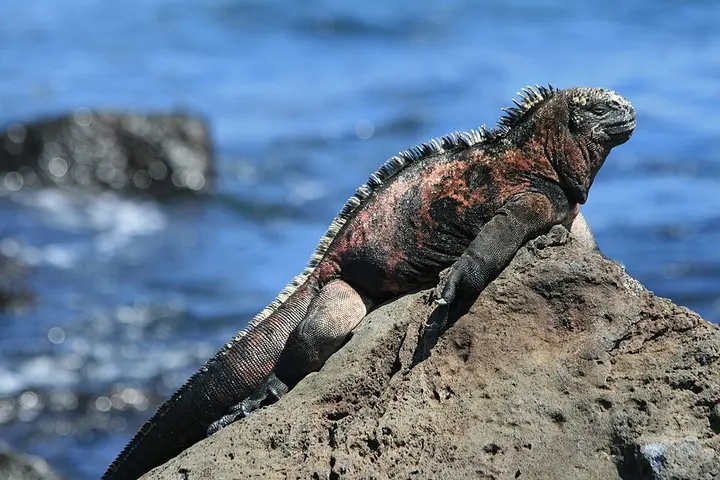
The marine iguana, also known as the sea iguana, saltwater iguana, or Galápagos marine iguana, is a species of iguana found only on the Galápagos Islands (Ecuador). Unique among modern lizards, it is a marine reptile that has the ability to forage in the sea for algae, which make up almost all of its diet. Marine iguanas are the only extant lizard that spends time in a marine environment.
Large males are able to dive to find this food source, while females and smaller males feed during low tide in the intertidal zone. They mainly live in colonies on rocky shores where they bask after visiting the relatively cold water or intertidal zone, but can also be seen in marshes, mangrove swamps and beaches. Large males defend territories for a short period, but smaller males have other breeding strategies. After mating, the female digs a nest hole in the soil where she lays her eggs, leaving them to hatch on their own a few months later. Marine iguanas vary in appearance between the different islands and several subspecies are recognized.
Appearance
The guanas are small, and of a sooty black, which, if possible, heightens their native ugliness. Indeed, so disgusting is their appearance, that no one on board could be prevailed on, to take them as food. The black Lava rocks on the beach are frequented by large (2–3 ft [0.6–0.9 m]), most disgusting, clumsy Lizards. They are as black as the porous rocks over which they crawl & seek their prey from the Sea. Somebody calls them 'imps of darkness'.
Behaviour
Female marine iguanas reach sexual maturity at the age of 3–5 years, while males reach sexual maturity at the age of 6–8 years. Sexual maturity is marked by the first steep and abrupt decline in bone growth cycle thickness. Marine iguanas can reach an age of up to 60 years, but average lifespan is 12 years or less. Reproduction in the marine iguana begins during the last part of the cold and dry season, with breeding from December to March and nesting from January to April.
Diet
The marine iguana forages almost exclusively on red and green algae in the inter- and subtidal zones. At least 10 genera of algae are regularly consumed, including the red algae Centroceras, Gelidium, Grateloupia, Hypnea, Polysiphonia and Pterocladiella. In some populations, the green algae Ulva dominates the diet. The algal diet varies depending on algal abundance, individual preferences, foraging behaviour, season and exact island of feeding.
Life cycle
Female marine iguanas reach sexual maturity at the age of 3–5 years, while males reach sexual maturity at the age of 6–8 years. Sexual maturity is marked by the first steep and abrupt decline in bone growth cycle thickness. Marine iguanas can reach an age of up to 60 years, but average lifespan is 12 years or less. Reproduction in the marine iguana begins during the last part of the cold and dry season, with breeding from December to March and nesting from January to April.
Where the Marine iguana lives
Recorded in Ecuador (South America).
Most records fall in Galápagos.
See the Marine iguana’s range on the globe
Conservation status
Vulnerable (VU). At risk: it could become endangered. Categories are the IUCN Red List as republished by GBIF.
Sources
The range is a density of 8,834 georeferenced GBIF records, shown on the continents where it is mainly recorded, not an expert-drawn map. Description from Wikipedia.