Animals / Mammal
Maned wolf
Chrysocyon brachyurus · Canidae
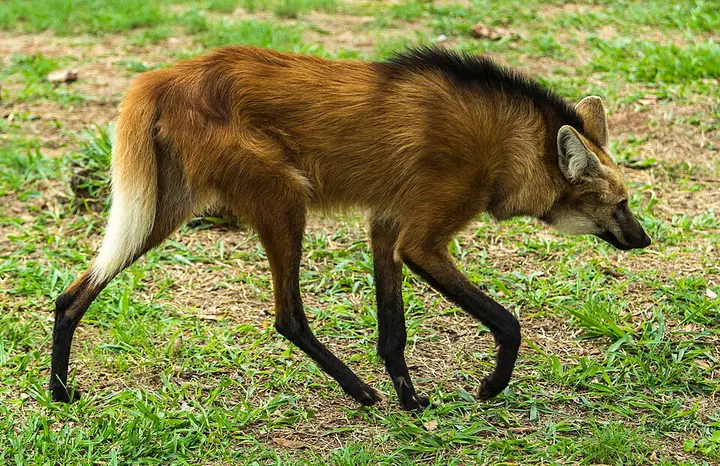
The maned wolf is a large canine of South America. It is found in Argentina, Brazil, Bolivia, Peru, and Paraguay, and is almost locally extinct in Uruguay. Its markings resemble those of a red fox but it is neither a fox nor a wolf.
It is the only species in the genus Chrysocyon (from Greek χρῡσο-κύων [chrúso-kúōn], "golden dog"). The maned wolf's young pups appear to have darker fur than the bronze, grown ones. It is the largest canine in South America, weighing 20–30 kg (44–66 lb) and up to 110 cm (43 in) at the withers. Its slender legs and dense reddish coat give it a distinctive appearance. The maned wolf is a crepuscular and omnivorous animal adapted to the open environments of the South American savanna, with an important role in the seed dispersal of fruits, especially the wolf apple (Solanum lycocarpum). The maned wolf is a solitary animal. It communicates primarily by scent marking, but also gives a loud call known as "roar-barking".
Appearance
The species was described in 1815 by Johann Karl Wilhelm Illiger, initially as Canis brachyurus. Lorenz Oken classified it as Vulpes cancosa, and only in 1839 did Charles Hamilton Smith describe the genus Chrysocyon. Other authors later considered it as a member of the Canis genus. Fossils of Chrysocyon dated from the Late Pleistocene and Holocene epochs were collected in one of Peter Wilheim Lund expeditions to Lagoa Santa, Minas Gerais (Brazil).
Behaviour
The maned wolf is a twilight animal, but its activity pattern is more related to the relative humidity and temperature, similar to that observed with the bush dog (Speothos venaticus). Peak activity occurs between 8 and 10 am, and 8 and 10 pm. On cold or cloudy days, they can be active all day. The species is likely to use open fields for foraging and more closed areas, such as riparian forests, to rest, especially on warmer days.
Diet
The maned wolf is omnivorous. It specialises in preying on small and medium-sized animals, including small mammals (typically rodents and rabbits), birds and their eggs, reptiles, and even fish, gastropods, other terrestrial molluscs, and insects, but the main portion of its diet is vegetable matter, including fruit, sugarcane, tubers, bulbs, and other roots. Up to 301 food items have been recorded in the maned wolf's diet, including 116 plants and 178 animal species.
Life cycle
Their mating season ranges from November to April. Gestation lasts 60 to 65 days, and a litter may have from two to six black-furred pups, each weighing roughly 450 g (16 oz). Pups are fully grown when one year old. During that first year, the pups rely on their parents for food. Data on the maned wolf's estrus and reproductive cycle mainly come from captive animals, particularly about breeding endocrinology.
Where the Maned wolf lives
Recorded in Brazil, Argentina and Paraguay (South America).
Most records fall in Minas Gerais, Goiás, São Paulo, Corrientes, Santa Fe and Formosa.
See the Maned wolf’s range on the globe
Conservation status
Near threatened (NT). Not at risk yet, but could be soon. Categories are the IUCN Red List as republished by GBIF.
Sources
The range is a density of 1,960 georeferenced GBIF records, shown on the continents where it is mainly recorded, not an expert-drawn map. Description from Wikipedia.