Animals / Mammal
Mandrill
Mandrillus sphinx · Cercopithecidae
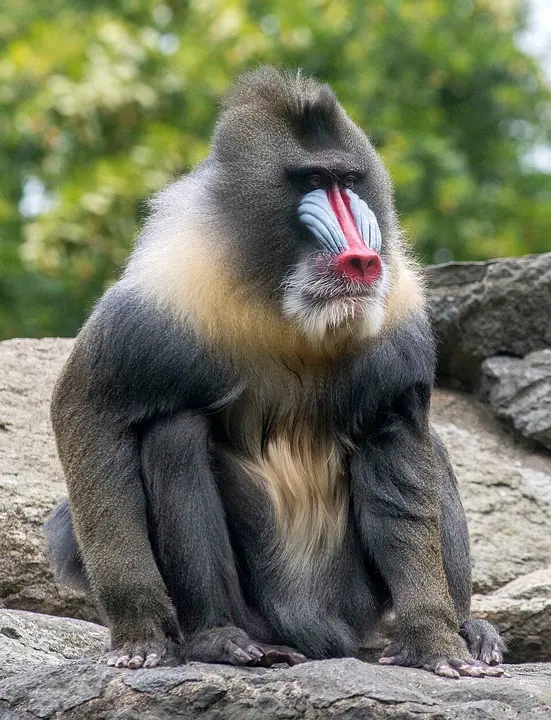
The mandrill is a large Old World monkey native to west central Africa. It is one of the most colorful mammals in the world, with red and blue skin on its face and posterior. The species is sexually dimorphic, as males have a larger body, longer canine teeth and brighter coloring.
Its closest living relative is the drill, with which it shares the genus Mandrillus. Both species were traditionally thought to be baboons, but further evidence has shown that they are more closely related to white-eyelid mangabeys. Mandrills mainly live in tropical rainforests but will also travel across savannas. They are active during the day and spend most of their time on the ground. Their preferred foods are fruit and seeds, but mandrills will consume leaves, piths, mushrooms, and animals from insects to juvenile bay duiker. Mandrills live in large, stable groups known as "hordes" which can number in the hundreds. Females form the core of these groups, while adult males are solitary and only reunite with the larger groups during the breeding season.
Appearance
The mandrill has a stocky body with a large head and muzzle, as well as a short and stumpy tail. The limbs are evenly sized and the fingers and toes are more elongated than those in baboons, with a more opposable big toe on the feet. The mandrill is the most sexually dimorphic primate, and it is the largest monkey. Females are less stocky and have shorter, flatter snouts.
Behaviour
The mandrill lives in west-central Africa, including southern Cameroon, mainland Equatorial Guinea (Río Muni), Gabon and parts of the Republic of the Congo. Its range is bounded by the Sanaga River to the north and the Ogooué and Ivindo Rivers to the east. It does not appear to share habitat with the drill, as the two species are separated by the Sanaga River. Mandrills live in tropical rainforests, generally preferring primary forests over secondary forests.
Diet
The mandrill is an omnivore. The core of its diet consists of plants, of which it eats over a hundred species. In Lopé National Park, the mandrill's diet was composed of fruit (50.7%), seeds (26.0%), leaves (8.2%), pith (6.8%), flowers (2.7%), and animal matter (4.1%), with other foods making up the remaining 1.4%.
Life cycle
Dominant or alpha male mandrills have the most mating success. Upon gaining alpha status, males develop larger testicles, redder faces and posteriors, more secretion from the chest glands and fatter sides and rumps. When a male loses dominance, these physiological changes are at least partially reversed. The blue facial skin is more consistent in brightness. Higher ranking males tend to have more contrast between red and blue facial coloring.
Where the Mandrill lives
Recorded in Gabon, Cameroon, Eq. Guinea and Guinea (Africa).
Most records fall in Haut-Ogooué, Ogooué-Ivindo, Sud, Ogooué-Lolo, Moyen-Ogooué and Centro Sur.
See the Mandrill’s range on the globe
Conservation status
Vulnerable (VU). At risk: it could become endangered. Categories are the IUCN Red List as republished by GBIF.
Sources
The range is a density of 171 georeferenced GBIF records, shown on the continents where it is mainly recorded, not an expert-drawn map. Description from Wikipedia.