Animals / Bird
Mallard
Anas platyrhynchos · Anatidae
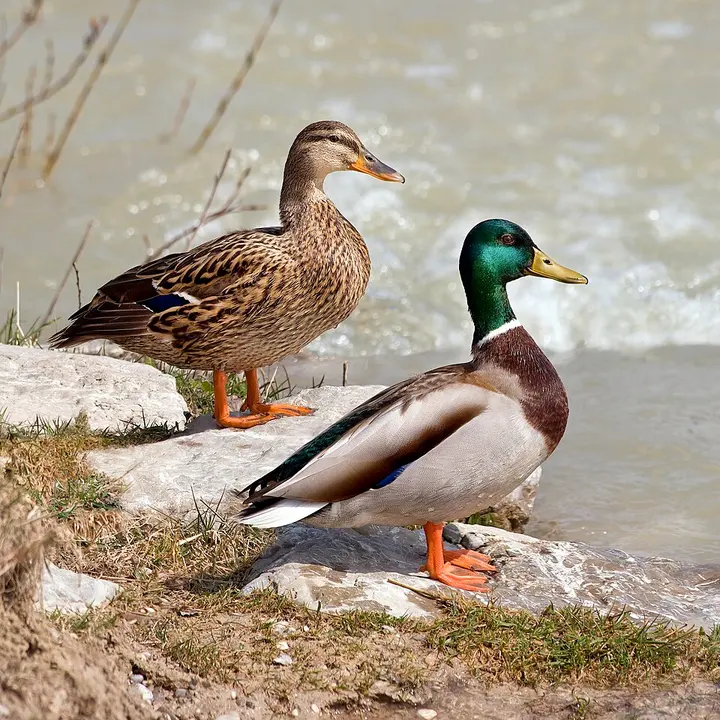
The mallard or wild duck is a dabbling duck that breeds throughout temperate and subtropical North America, Eurasia, and North Africa. It has been introduced to New Zealand, Australia, Peru, Brazil, Uruguay, Argentina, Chile, Colombia, the Falkland Islands, and South Africa. Belonging to the subfamily Anatinae of the waterfowl family Anatidae, mallards live in wetlands, eat water plants and small animals, and are social animals preferring to congregate in groups or flocks of varying sizes.
Males (drakes) have green heads, while the females (ducks) have mainly brown-speckled plumage. Both sexes have an area of white-bordered black or iridescent purple or blue feathers called a speculum on their wings; males especially tend to have blue speculum feathers. The mallard is 50–65 cm (20–26 in) long, of which the body makes up around two-thirds the length. The wingspan is 81–98 cm (32–39 in) and the bill is 4.4 to 6.1 cm (1.7 to 2.4 in) long. It is often slightly heavier than most other dabbling ducks, weighing 0.7–1.6 kg (1.5–3.5 lb). The female lays 8 to 13 creamy white to greenish-buff spotless eggs, on alternate days. Incubation takes 27 to 28 days and fledging takes 50 to 60 days. The ducklings are precocial and fully capable of swimming as soon as they hatch.
Appearance
The mallard is a medium-large waterfowl species that is heavier than most other dabbling ducks. It is 50–65 cm (20–26 in) long, of which the body makes up around two-thirds, and has a wingspan of 81–98 cm (32–39 in); it weighs 0.7–1.6 kg (1.5–3.5 lb). Among standard measurements, the wing chord is 25.7 to 30.6 cm (10.1 to 12.0 in), the bill is 4.4 to 6.1 cm (1.7 to 2.4 in), and the tarsus is 4.1 to 4.8 cm (1.6 to 1.9 in).
Behaviour
The mallard is omnivorous and very flexible in its choice of food. Its diet may vary based on several factors, including the stage of the breeding cycle, short-term variations in available food, nutrient availability, and interspecific and intraspecific competition.
Diet
The mallard is omnivorous and very flexible in its choice of food. Its diet may vary based on several factors, including the stage of the breeding cycle, short-term variations in available food, nutrient availability, and interspecific and intraspecific competition.
Habitat
The mallard is widely distributed across the Northern and Southern Hemispheres; in North America its range extends from southern and central Alaska to Mexico, the Hawaiian Islands, across the Palearctic, from Iceland and southern Greenland and parts of Morocco (North Africa) in the west, Scandinavia and Britain to the north, and to Siberia, Japan, and South Korea.
Life cycle
Mallards usually form pairs (in October and November in the Northern Hemisphere) until the female lays eggs at the start of the nesting season, which is around the beginning of spring. At this time she is left by the male who joins up with other males to await the moulting period, which begins in June (in the Northern Hemisphere).
Where the Mallard lives
Recorded in United States of America, Canada, Sweden, United Kingdom, Netherlands, Norway, Denmark, France, Spain and Germany (North America and Europe).
Most records fall in California, Ontario, New York, Québec, Washington and Michigan.
See the Mallard’s range on the globe
Conservation status
Least concern (LC). Not at risk: it is doing well in the wild. Categories are the IUCN Red List as republished by GBIF.
Sources
The range is a density of 29,734,782 georeferenced GBIF records, shown on the continents where it is mainly recorded, not an expert-drawn map. Description from Wikipedia.