Animals / Mammal
Malayan tapir
Tapirus indicus · Tapiridae
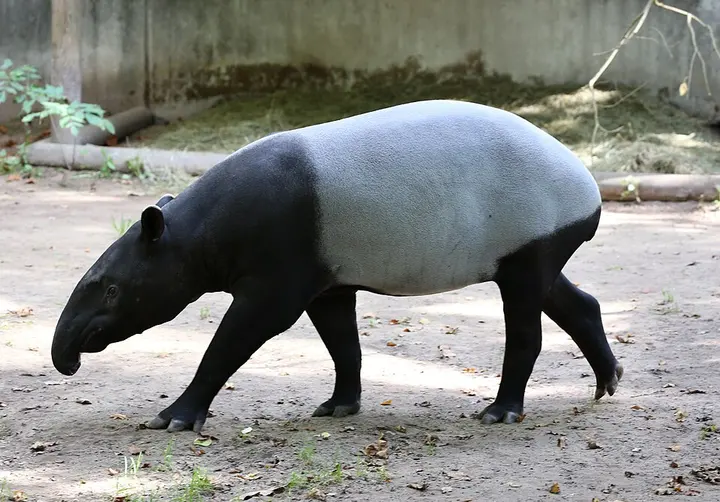
The Malayan tapir, also called Asian tapir, Asiatic tapir, oriental tapir, Indian tapir, piebald tapir, or black-and-white tapir, is the only living tapir species outside of the Americas. It is native to Southeast Asia from the Malay Peninsula to Sumatra. It has been listed as Endangered on the IUCN Red List since 2008, as the population is estimated to comprise fewer than 2,500 mature individuals.
Appearance
The Malayan tapir is easily identified by its markings, most notably the light-colored patch that extends from its shoulders to its hindquarters. Black hair covers its head, shoulders, and legs, while white hair covers its midsection, rear, and the tips of its ears; these white edges around the rims of the outer ear as is true of other tapirs.
Behaviour
Malayan tapirs are primarily solitary, marking out large tracts of land as their territory, though these areas usually overlap with those of other individuals. Tapirs mark out their territories by spraying urine on plants, and they often follow distinct paths which they have bulldozed through the undergrowth.
Habitat
The Malayan tapir lives throughout primary and secondary lowland tropical forests of Southeast Asia, including Sumatra in Indonesia, Peninsular Malaysia, Myanmar, and Thailand. Pleistocene fossils were found in Java and other locations accompanied by herbivores more typical of grasslands, indicating that it evolved in more open habitats and retreated to closed forests in later times.
Life cycle
The gestation period of the Malayan tapir is about 390–395 days, after which a single calf is born that weighs around 6.8 kg (15 lb). Malayan tapirs are the largest of the four tapir species at birth and tend to grow more quickly than their relatives. Young tapirs of all species have brown hair with white stripes and spots, a pattern that enables them to hide effectively in the dappled light of the forest.
Where the Malayan tapir lives
Recorded in Malaysia, Indonesia and Thailand (Asia).
Most records fall in Pahang, Selangor, Johor, Negeri Sembilan, Terengganu and Perak.
See the Malayan tapir’s range on the globe
Conservation status
Endangered (EN). In danger of dying out in the wild. Categories are the IUCN Red List as republished by GBIF.
Sources
The range is a density of 142 georeferenced GBIF records, shown on the continents where it is mainly recorded, not an expert-drawn map. Description from Wikipedia.