Animals / Bird
Macaroni penguin
Eudyptes chrysolophus · Spheniscidae
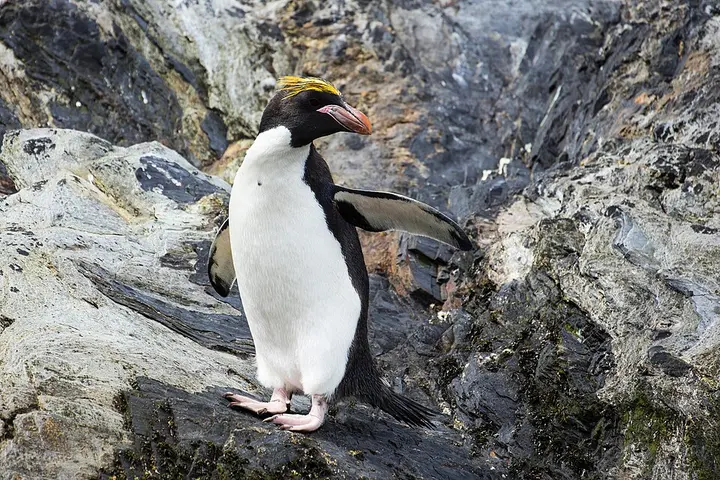
The macaroni penguin is a species of penguin found from the Subantarctic to the Antarctic Peninsula. One of eight species of crested penguin, it is very closely related to the royal penguin, and some authorities consider the two to be a single species. It bears a distinctive yellow crest on its forehead.
Its face and upperparts are black and sharply delineated from the white underparts. Adults weigh on average 5.5 kg (12 lb) and are 70 cm (28 in) in length. The male and female are similar in appearance; the male is slightly larger and stronger with a larger bill. Like all penguins, it is flightless, with a streamlined body and wings stiffened and flattened into flippers for a marine life. Its diet consists of a variety of crustaceans, mainly krill, as well as small fish and cephalopods; the species consumes more marine life annually than any other species of seabird. These birds moult once a year, spending about three to four weeks ashore, before returning to the sea.
Appearance
The macaroni penguin is a large, crested penguin, similar in appearance to other members of the genus Eudyptes. An adult bird has an average length of around 70 cm (28 in); the weight varies markedly depending on time of year and sex. Males average from 3.3 kg (7 lb) after incubating, or 3.7 kg (8 lb) after moult to 6.4 kg (14 lb) before moult, while females average 3.2 kg (7 lb) after to 5.7 kg (13 lb) before moult.
Behaviour
The diet of the macaroni penguin consists of a variety of crustaceans, squid and fish; the proportions that each makes up vary with locality and season. Krill, particularly Antarctic krill (Euphausia superba), account for over 90% of food during breeding season.
Diet
The diet of the macaroni penguin consists of a variety of crustaceans, squid and fish; the proportions that each makes up vary with locality and season. Krill, particularly Antarctic krill (Euphausia superba), account for over 90% of food during breeding season.
Habitat
A 1993 review estimated that the macaroni was the most abundant species of penguin, with a minimum of 11,841,600 pairs worldwide. Macaroni penguins range from the Subantarctic to the Antarctic Peninsula; at least 216 breeding colonies at 50 sites have been recorded. In South America, macaroni penguins are found in southern Chile, the Falkland Islands, South Georgia and the South Sandwich Islands, and South Orkney Islands.
Life cycle
Like most other penguin species, the macaroni penguin is a social animal in its nesting and its foraging behaviour; its breeding colonies are among the largest and most densely populated. Scientist Charles Andre Bost found that macaroni penguins nesting at Kerguelen dispersed eastwards over an area exceeding 3 million km2.
Where the Macaroni penguin lives
Recorded in S. Geo. and the Is., Heard I. and McDonald Is., South Africa, Falkland Is. and Antarctica (Seven seas (open ocean), Africa, South America and Antarctica).
Most records fall in Western Cape.
See the Macaroni penguin’s range on the globe
Conservation status
Vulnerable (VU). At risk: it could become endangered. Categories are the IUCN Red List as republished by GBIF.
Sources
The range is a density of 83,389 georeferenced GBIF records, shown on the continents where it is mainly recorded, not an expert-drawn map. Description from Wikipedia.