Animals / Mammal
Little brown bat
Myotis lucifugus · Vespertilionidae
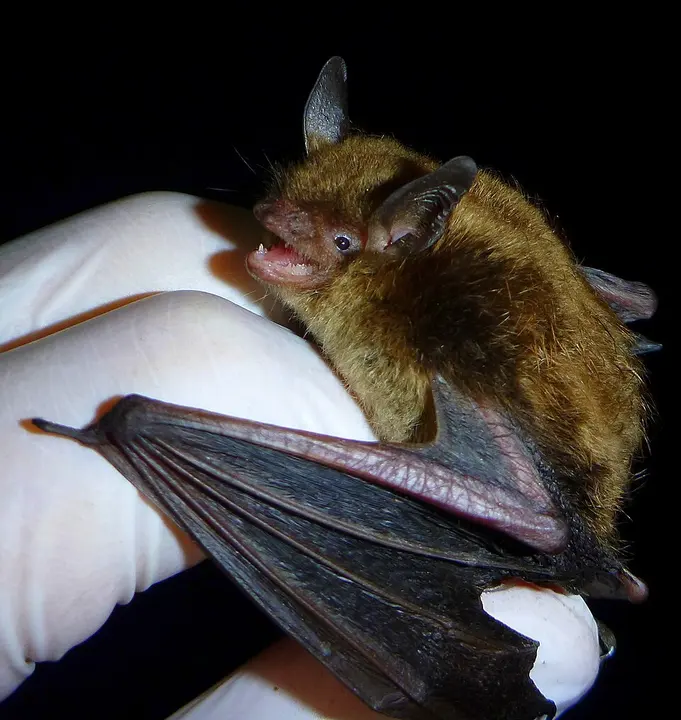
The little brown bat or little brown myotis is an endangered species of mouse-eared microbat found in North America. It has a small body size and glossy brown fur. It is similar in appearance to several other mouse-eared bats, including the Indiana bat, northern long-eared bat, and Arizona myotis, to which it is closely related.
Despite its name, the little brown bat is not closely related to the big brown bat, which belongs to a different genus. Its mating system is polygynandrous, or promiscuous, and females give birth to one offspring annually. The offspring, called pups, are quickly weaned and reach adult size in some dimensions by three weeks old. The little brown bat has a lifespan of 34-35 years. It is nocturnal, foraging for its insect prey at night and roosting in hollow trees or buildings during the day, among less common roost types. It navigates and locates prey with echolocation. It has few natural predators, but may be killed by raptors such as owls, as well as terrestrial predators such as raccoons. Other sources of mortality include diseases such as rabies and white-nose syndrome.
Appearance
The little brown bat is a small species, with individuals weighing 5.5–12.5 g (0.19–0.44 oz) with a total body length of 8.0–9.5 cm (3.1–3.7 in). Individuals have the lowest weight in the spring as they emerge from hibernation. It has a forearm length of 36–40 mm (1.4–1.6 in) and a wingspan of 22.2–26.9 cm (8.7–10.6 in). It is a sexually dimorphic species, with females larger than males on average.
Behaviour
The little brown bat is a colonial species, with hibernating colonies consisting of up to 183,500 individuals, though the average colony size is little more than 9,000. Historically, individuals within these colonies were highly aggregated and densely clustered together, though the disease white-nose syndrome is making solitary hibernation more common. During the spring and summer, maternity colonies of almost all female individuals form.
Life cycle
The little brown bat has a promiscuous mating structure, meaning that individual bats of both sexes mate with multiple partners. It is a seasonal breeder, with mating taking place in the fall before the annual hibernation. As a seasonal breeder, males do not produce sperm year-round; instead, spermatogenesis occurs May through August each year. Throughout the spring and summer, males and females roost separately.
Where the Little brown bat lives
Recorded in United States of America and Canada (North America).
Most records fall in Alaska, New York, Colorado, California, New Brunswick and Michigan.
See the Little brown bat’s range on the globe
Conservation status
Endangered (EN). In danger of dying out in the wild. Categories are the IUCN Red List as republished by GBIF.
Sources
The range is a density of 10,653 georeferenced GBIF records, shown on the continents where it is mainly recorded, not an expert-drawn map. Description from Wikipedia.