Animals / Jellyfish
Lion's mane jellyfish
Cyanea capillata · Cyaneidae
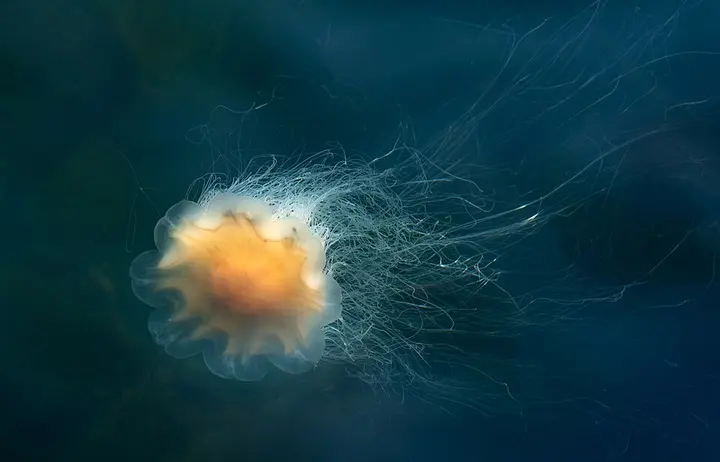
The lion's mane jellyfish is one of the largest known species of jellyfish. Its range is confined to cold, boreal waters of the Arctic, northern Atlantic, and northern Pacific Oceans. It is common in the English Channel, Irish Sea, North Sea, and in western Scandinavian waters south to Kattegat and Øresund.
Some may also drift outside of their usual perimeters during periods of increased warming, including into the southwestern part of the Baltic Sea (where it cannot breed due to the low salinity). Similar jellyfish – which may be the same species – are known to inhabit seas near Australia and New Zealand. The largest recorded specimen was measured off the coast of Massachusetts in 1865 and had a bell with a diameter of 210 centimetres (7 feet) and tentacles around 36.6 m (120 ft) long. Lion's mane jellyfish have been observed below 42°N latitude for some time in the larger bays of the East Coast of the United States.
Appearance
Lion's mane jellyfish (Cyanea capillata) are named for their showy, trailing tentacles reminiscent of a lion's mane. They can vary greatly in size: although capable of attaining a bell diameter of over 2 m (6 ft 7 in), those found in lower latitudes are normally smaller than their far northern counterparts, with a bell about 50 cm (20 in) in diameter. Furthermore, larger specimens are typically further offshore than smaller ones.
Where the Lion's mane jellyfish lives
Recorded in Norway, Canada, United Kingdom, Sweden, Netherlands, Denmark, Ireland, Germany and United States of America (Europe and North America).
Most records fall in Vestfold, Västra Götaland, Rogaland, British Columbia, Aust-Agder and Noord-Holland.
See the Lion's mane jellyfish’s range on the globe
Conservation status
Not evaluated (NE). Scientists haven’t checked yet how at risk it is, so this doesn’t mean it is safe or in danger. Categories are the IUCN Red List as republished by GBIF.
Sources
The range is a density of 16,775 georeferenced GBIF records, shown on the continents where it is mainly recorded, not an expert-drawn map. Description from Wikipedia.