Animals / Mammal
Lion
Panthera leo · Felidae
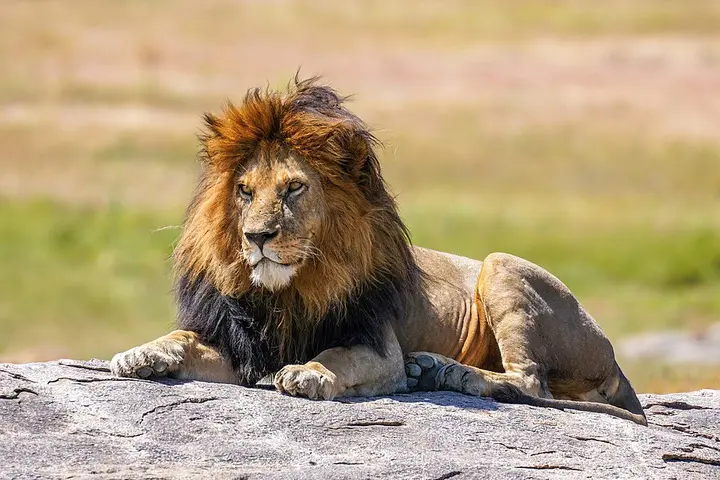
The lion is a large cat of the genus Panthera, currently ranging only in Sub-Saharan Africa and India. It has a muscular, broad-chested body; a short, rounded head; round ears; and a dark, hairy tuft at the tip of its tail. It is sexually dimorphic; adult male lions are larger than females and have a prominent mane that extends from the head to the shoulders and chest.
The lion inhabits grasslands, savannahs, and shrublands. It is an apex and keystone predator, preying mostly on medium-sized and large hooved mammals. It is usually more diurnal than other wild cats, but when persecuted, it adapts to being active at night and at twilight. It is a social species, forming groups called prides. A lion pride consists of related females and cubs, and a few or one adult male who is unrelated to the females. Groups of female lions usually hunt together. Adult males often compete to keep or gain their membership in the pride. During the Neolithic period, the lion ranged throughout Africa and Eurasia, from southeastern Europe to India. It has been reduced to fragmented populations in sub-Saharan Africa and one population in western India.
Appearance
The lion is a muscular, broad-chested cat with a short, rounded head, a reduced neck, and round ears; males have broader heads. The fur varies in colour from light buff to silvery grey, yellowish red, and dark brown. The colours of the underparts are generally lighter. A newborn lion has dark spots, which fade as the cub reaches adulthood, although faint spots may still be seen on the legs and underparts.
Behaviour
Lions spend much of their time resting; they are inactive for about twenty hours per day. Although lions can be active at any time, their activity generally peaks after dusk with a period of socialising, grooming, and defecating. Intermittent bursts of activity continue until dawn, when hunting most often takes place. They spend an average of two hours a day walking and fifty minutes eating.
Habitat
African lions live in scattered populations across sub-Saharan Africa. The lion prefers grassy plains and savannahs, scrub bordering rivers, and open woodlands with bushes. It rarely enters closed forests. On Mount Elgon, the lion has been recorded up to an elevation of 3,600 m (11,800 ft) and close to the snow line on Mount Kenya.
Life cycle
Most lionesses reproduce by the time they are four years of age. Lions do not mate at a specific time of year, and the females are polyestrous. Like other cats, lions have penile spines that rake the walls of the vagina during copulation, which may cause ovulation. A lioness may mate with more than one male when she is in heat. Lions of both sexes may be involved in group homosexual and courtship activities.
Where the Lion lives
Recorded in South Africa, Kenya, Tanzania, Botswana, Namibia, Benin, Uganda, Zambia and Zimbabwe (Africa).
Most records fall in Rift Valley, Mpumalanga, Arusha, North-West, Mara and Limpopo.
See the Lion’s range on the globe
Conservation status
Vulnerable (VU). At risk: it could become endangered. Categories are the IUCN Red List as republished by GBIF.
Sources
The range is a density of 16,456 georeferenced GBIF records, shown on the continents where it is mainly recorded, not an expert-drawn map. Description from Wikipedia.