Animals / Mammal
Linnaeus's two-toed sloth
Choloepus didactylus · Megalonychidae
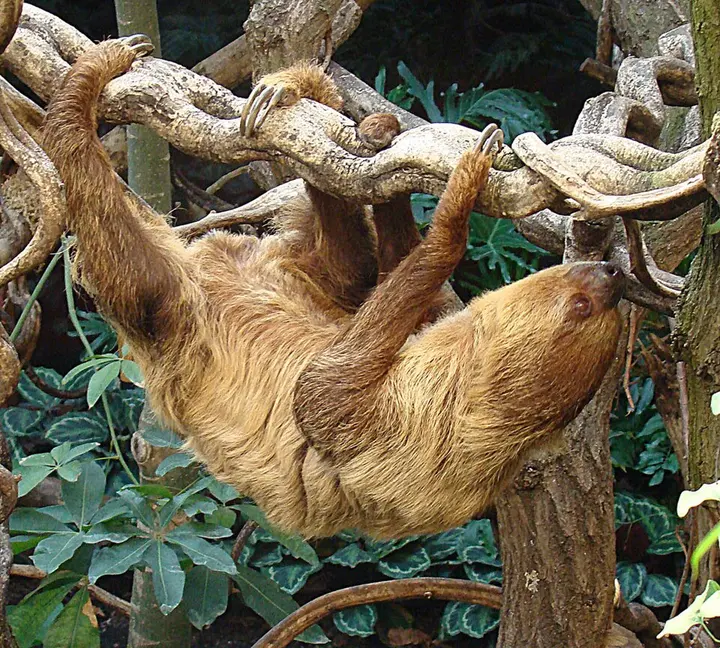
Linnaeus's two-toed sloth, also known as the southern two-toed sloth, unau, or Linne's two-toed sloth is a species of sloth from South America, found in Venezuela, Suriname, Guyana, French Guiana, Colombia, Ecuador, Peru, and Brazil north of the Amazon River. There is now evidence suggesting the species' range expands into Bolivia. It's the largest extant sloth species.
Appearance
Males and females are the same size, growing to lengths of approximately 53 to 89 cm (21 to 35 in), not including the length of the tail, and weigh approximately 4 to 11 kg (9 to 24 lb). Their fur color ranges from a brownish yellow to a pale tone of brown, however, in the wild their fur sometimes has a green hue from algae that grows on their fur during the rainy season. Their belly fur is slightly lighter in color than the body and they have no undercoat.
Behaviour
C. didactylus is a solitary, nocturnal and arboreal animal, found in rainforests. The two-toed sloth falls prey to South American coatis and wild cats such as the ocelot, margay and jaguar as well as harpy eagles. Predation mainly occurs when the sloth descends to the ground in order to defecate or change trees. Anacondas have also been known to hunt sloths.
Where the Linnaeus's two-toed sloth lives
Recorded in Ecuador, Brazil, Colombia, Suriname, Peru and Guyana (South America).
Most records fall in Sucumbios, Amazonas, Loreto, Orellana, Meta and Pará.
See the Linnaeus's two-toed sloth’s range on the globe
Conservation status
Least concern (LC). Not at risk: it is doing well in the wild. Categories are the IUCN Red List as republished by GBIF.
Sources
The range is a density of 687 georeferenced GBIF records, shown on the continents where it is mainly recorded, not an expert-drawn map. Description from Wikipedia.