Animals / Mammal
Lesser kudu
Tragelaphus imberbis · Bovidae
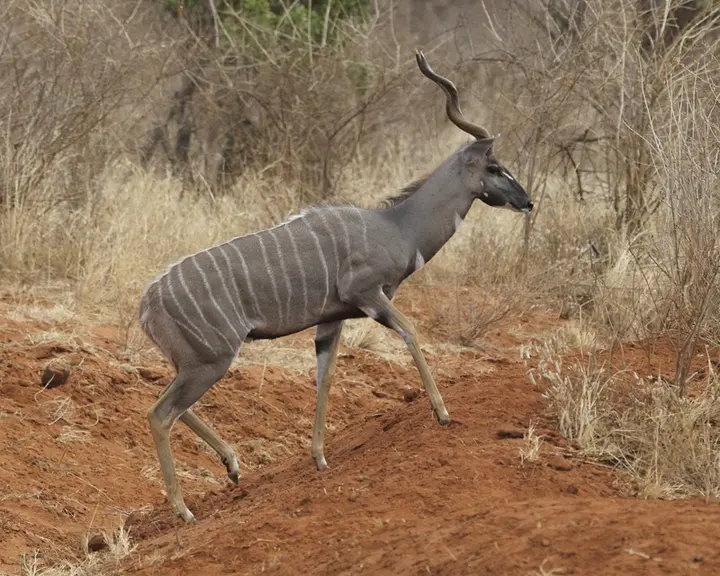
The lesser kudu is a medium-sized antelope found in East Africa. The species is not especially closely related to the greater kudu, though both belong the artiodactyl tribe Tragelaphini, of striped, spiral-horned African bovids, along with the nyala, elands, balbok, bushbucks, bongo, and sitatunga. It was first scientifically described by English zoologist Edward Blyth in 1869.
The species is sometimes assigned as the only species of the genus Ammelaphus, with that designation typically as a subgenus. The lesser kudu is a browser subsisting off of foliage from tall bushes, trees, and herbaceous perennial plants. They are not territorial, and mainly crepuscular, preferring to be active after dusk until the dawn hours, seeking shelter in dense thickets just after the sunrise. The Lesser Kudu inhabits dry bushland regions, bordering on arid grasslands, as well as scrubland and light open forest habitat. The lesser kudu is native to Ethiopia, Kenya, Somalia, South Sudan, Tanzania, and Uganda, but it is possibly extirpated from Djibouti.
Appearance
The lesser kudu is a spiral-horned antelope, characterised by large, rounded ears. The head-and-body length is typically between 110 and 140 cm (43 and 55 in). Males reach about 95–105 cm (37–41 in) at the shoulder, while females reach 90–100 cm (35–39 in). Males typically weigh 92–108 kg (203–238 lb) and females 56–70 kg (123–154 lb). The bushy tail is 25–40 cm (9.8–15.7 in) long, white underneath and with a black tip at the end.
Behaviour
The lesser kudu is mainly active at night and during the dawn, and seeks shelter in dense thickets just after the sunrise. The midday is spent in rest and rumination in shaded areas. They spend about equal time foraging, standing and lying, and roaming. The lesser kudu is a shy and wary animal. It can camouflage so well in dense vegetation such that only its ears and tail can indicate its presence.
Diet
The lesser kudu browses primarily at dusk or dawn, or nocturnally, and is sometimes associated with gerenuk and the impala. The lesser kudu and the gerenuk might compete for evergreen species in the dry season. However, unlike the long-necked gerenuk, the lesser kudu rarely consumes Acacia species, and does not stand on its hindlegs while feeding.
Habitat
The Lesser Kudu inhabits dry bushland regions. It is closely associated with Acacia and Commiphora thornbush in semiarid areas of northeastern Africa. The animal avoids open areas and long grass, preferring shaded areas with short grasses instead. Found in woodlands and hilly areas, as well, the lesser kudu is generally found at altitudes below 1,200 m (3,900 ft); though they have been recorded at heights about 1,740 m (5,710 ft) near Mount Kilimanjaro.
Where the Lesser kudu lives
Recorded in Kenya, Ethiopia, Tanzania and Somalia (Africa).
Most records fall in Coast, Eastern, Rift Valley, Oromiya, Kilimanjaro and Arusha.
See the Lesser kudu’s range on the globe
Conservation status
Near threatened (NT). Not at risk yet, but could be soon. Categories are the IUCN Red List as republished by GBIF.
Sources
The range is a density of 547 georeferenced GBIF records, shown on the continents where it is mainly recorded, not an expert-drawn map. Description from Wikipedia.