Animals / Mammal
Leopard
Panthera pardus · Felidae
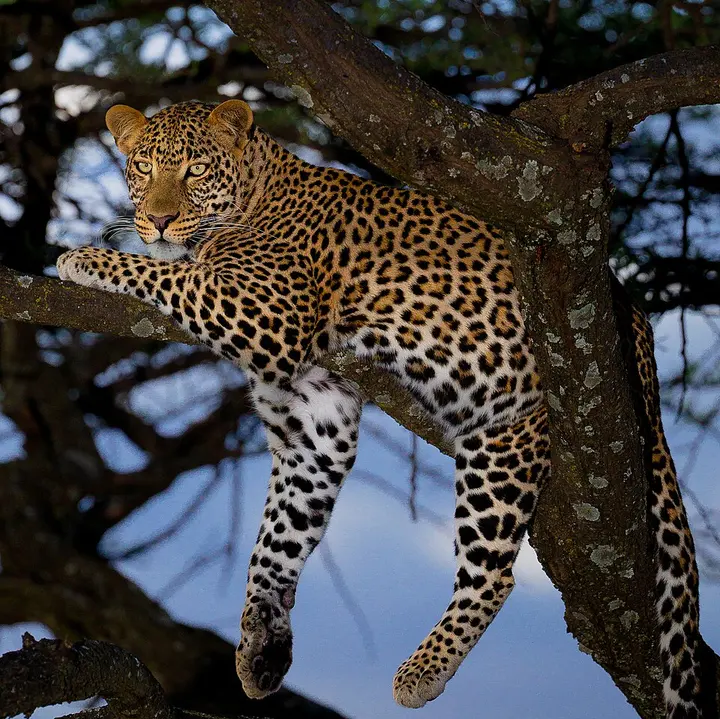
The leopard is one of the five extant cat species in the genus Panthera. It has a pale yellowish to dark golden fur with dark spots grouped in rosettes. Its body is slender and muscular, reaching a length of 92–183 cm (36–72 in) with a 66–102 cm (26–40 in) long tail and a shoulder height of 60–70 cm (24–28 in).
Males typically weigh 30.9–72 kg (68–159 lb), and females 20.5–43 kg (45–95 lb). The leopard was first described in 1758, and several subspecies were proposed in the 19th and 20th centuries. Today, eight subspecies are recognised in its wide range in Africa and Asia. It initially evolved in Africa during the Early Pleistocene, before migrating into Eurasia around the Early–Middle Pleistocene transition. Leopards were formerly present across Europe, but became extinct in the region at around the end of the Late Pleistocene-early Holocene. The leopard is adapted to a variety of habitats ranging from rainforest to steppe, including arid and montane areas. It is an opportunistic predator, hunting mostly ungulates and primates.
Appearance
The leopard's fur is generally soft and thick, notably softer on the belly than on the back. Its skin colour varies between individuals from pale yellowish to dark golden with dark spots grouped in rosettes. Its underbelly is white and its ringed tail is shorter than its body. Its pupils are round. Leopards living in arid regions are pale cream, yellowish to ochraceous and rufous in colour; those living in forests and mountains are much darker and deep golden.
Behaviour
The leopard is a solitary and territorial animal. It is typically shy and alert when crossing roadways and encountering oncoming vehicles, but may be emboldened to attack people or other animals when threatened. Adults associate only in the mating season. Females continue to interact with their offspring even after weaning and have been observed sharing kills with their offspring when they cannot obtain any prey.
Habitat
The leopard has the widest distribution of all wild cats, across Africa and Asia, although populations are fragmented and declining. It Ir inhabits savanna and rainforest, and grasslands, woodlands and riparian forests that remain largely undisturbed. It inhabits urban environments, if it is not persecuted, has sufficient prey and patches of vegetation for shelter. The leopard's range in West Africa is estimated to have declined by 95%, and in the Sahara desert by 97%.
Life cycle
In some areas, leopards mate all year round. In Manchuria and Siberia, they mate during January and February. On average, females begin to breed between the ages of 2½ and three, and males between the ages of two and three. The female's estrous cycle lasts about 46 days, and she is usually in heat for 6–7 days. Gestation lasts for 90 to 105 days. Cubs are usually born in a litter of 2–4 cubs. The mortality rate of cubs is estimated at 41–50% during the first year.
Where the Leopard lives
Recorded in South Africa, India, Tanzania, Israel, Kenya, Botswana, Sri Lanka, Namibia, Zambia and Uganda (Africa and Asia).
Most records fall in Mpumalanga, HaDarom, Rift Valley, Limpopo, North-West and Mara.
See the Leopard’s range on the globe
Conservation status
Vulnerable (VU). At risk: it could become endangered. Categories are the IUCN Red List as republished by GBIF.
Sources
The range is a density of 9,398 georeferenced GBIF records, shown on the continents where it is mainly recorded, not an expert-drawn map. Description from Wikipedia.