Animals / Mammal
Leopard cat
Prionailurus bengalensis · Felidae
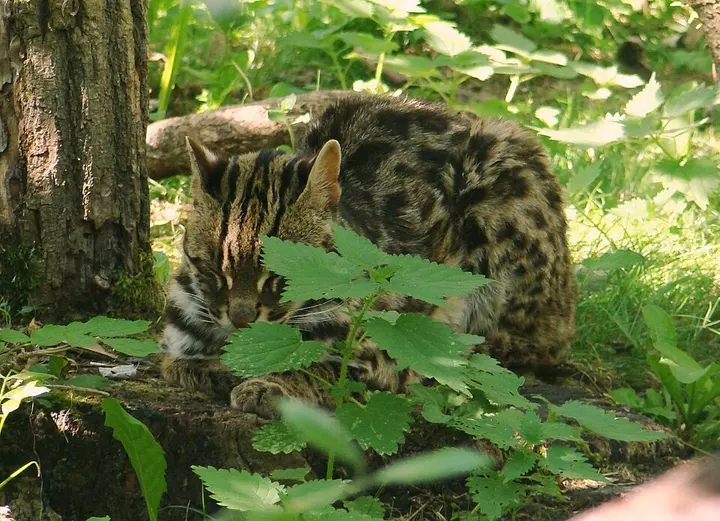
The leopard cat is a small wild cat with dark spots on the tawny-coloured body and limbs. It has two dark stripes running from the eyes to the ears and smaller white streaks running from the eyes to the nose, and two to four rows of elongated spots along its back. Its tail is about half the size of its head-to-body length.
The leopard cat is native to continental South, Southeast and East Asia. It inhabits tropical evergreen rainforests, subtropical deciduous and coniferous forests up to an elevation of 4,474 m (14,678 ft) in the Himalayas. Since 2002 it has been listed as Least Concern on the IUCN Red List as it is widely distributed although threatened by habitat loss and hunting in parts of its range.
Appearance
A leopard cat is about the size of a domestic cat, but more slender, with longer legs and well-defined webs between its toes. Its small head is marked with two prominent dark stripes and a short and narrow white muzzle. There are two dark stripes running from the eyes to the ears and smaller white streaks running from the eyes to the nose. The backs of its moderately long and rounded ears are black with central white spots.
Behaviour
Leopard cats are solitary, except during the breeding season. Some are active during the day, but most hunt at night, preferring to stalk murids, tree shrews and hares. They are agile climbers and quite arboreal in their habits. They rest in trees, but also hide in dense thorny undergrowth on the ground. There, leopard cats feed on a large proportion of rats compared to forested areas. Leopard cats can swim, but seldom do so.
Diet
Leopard cats are carnivorous, feeding on a variety of small prey including mammals, lizards, amphibians, birds and insects. In most parts of their range, small rodents such as rats and mice form the major part of their diet, which is often supplemented with grass, eggs, poultry, and aquatic prey. They are active hunters, dispatching their prey with a rapid pounce and bite.
Habitat
The leopard cat is the most widely distributed Asian small wild cat. Its range extends from eastern Afghanistan, northern Pakistan and large parts of the Indian subcontinent and Southeast Asia to the Russian Far East. It lives in tropical evergreen rainforests and plantations at sea level, in subtropical deciduous and coniferous forests in the foothills of the Himalayas at elevations above 1,000 m (3,300 ft).
Life cycle
The breeding season of the leopard cat varies depending on the climate. In tropical habitats, kittens are born throughout the year. In colder habitats farther north, females give birth in spring. Their gestation period lasts 60–70 days. Litter size varies between two and three kittens. Captive-born kittens weighed 75 to 130 g (2.6 to 4.6 oz) at birth and opened their eyes by 15 days of age.
Where the Leopard cat lives
Recorded in South Korea, China, Malaysia, Cambodia, Indonesia, India and Thailand (Asia).
Most records fall in North Jeolla, North Gyeongsang, Gangwon, Gyeonggi, South Chungcheong and South Gyeongsang.
See the Leopard cat’s range on the globe
Conservation status
Least concern (LC). Not at risk: it is doing well in the wild. Categories are the IUCN Red List as republished by GBIF.
Sources
The range is a density of 4,049 georeferenced GBIF records, shown on the continents where it is mainly recorded, not an expert-drawn map. Description from Wikipedia.