Animals / Reptile
Leatherback sea turtle
Dermochelys coriacea · Dermochelyidae
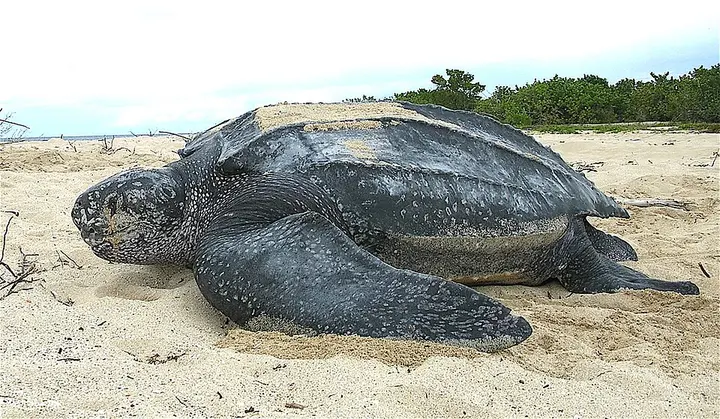
The leatherback sea turtle, sometimes called the lute turtle, leathery turtle or simply the luth, is a large species of sea turtle. The largest of all living turtles and the heaviest non-crocodilian reptile, it reaches lengths of up to 2.7 metres and weights of 500 kilograms (1,100 lb). It is the only living species in the genus Dermochelys and family Dermochelyidae.
It can easily be differentiated from other modern sea turtles by its lack of a bony shell; instead, its carapace is covered by oily flesh and flexible, leather-like skin, for which it is named. Leatherback turtles have a global range, although there are multiple distinct subpopulations. The species as a whole is considered vulnerable, and some of its subpopulations are critically endangered.
Appearance
Leatherback turtles have the most hydrodynamic body of any sea turtle, with a large, teardrop-shaped body. A large pair of front flippers powers the turtles through the water. Like other sea turtles, the leatherback has flattened forelimbs adapted for swimming in the open ocean. Claws are absent from both pairs of flippers. The leatherback's flippers are the largest in proportion to its body among extant sea turtles.
Diet
Adult D. coriacea turtles subsist almost entirely on jellyfish. Due to their obligate feeding nature, leatherbacks help control jellyfish populations. Leatherbacks also feed on other soft-bodied organisms, such as other cnidarians (siphonophores), tunicates (salps and pyrosomas) and cephalopods (squid). They are also believed to feed on small crustaceans (amphipods and crabs), fish (possibly symbiotes with jellies), sea urchins, snails, seagrasses, and algae.
Habitat
The leatherback turtle is a species with a cosmopolitan global range. Of all the extant sea turtle species, D. coriacea has the widest distribution, reaching as far north as Alaska and Norway and as far south as Cape Agulhas in Africa and the southernmost tip of New Zealand. The leatherback is found in all tropical and subtropical oceans, and its range extends well into the Arctic Circle.
Life cycle
Leatherback turtles face many predators in their early lives. Eggs may be preyed on by a diversity of coastal predators, including ghost crabs, monitor lizards, raccoons, coatis, dogs, coyotes, genets, mongooses, and shorebirds ranging from small plovers to large gulls. Many of the same predators feed on baby turtles as they try to get to the ocean, as well as frigatebirds and varied raptors.
Where the Leatherback sea turtle lives
Recorded in United States of America, South Africa, France, Ireland, Colombia, Mozambique, United Kingdom, Ashmore and Cartier Is., Portugal and Namibia (North America, Africa, Europe, South America and Oceania).
Most records fall in Florida, Chocó, Cork, Georgia, Vendée and KwaZulu-Natal.
See the Leatherback sea turtle’s range on the globe
Conservation status
Vulnerable (VU). At risk: it could become endangered. Categories are the IUCN Red List as republished by GBIF.
Sources
The range is a density of 29,035 georeferenced GBIF records, shown on the continents where it is mainly recorded, not an expert-drawn map. Description from Wikipedia.