Animals / Bird
Laughing kookaburra
Dacelo novaeguineae · Alcedinidae
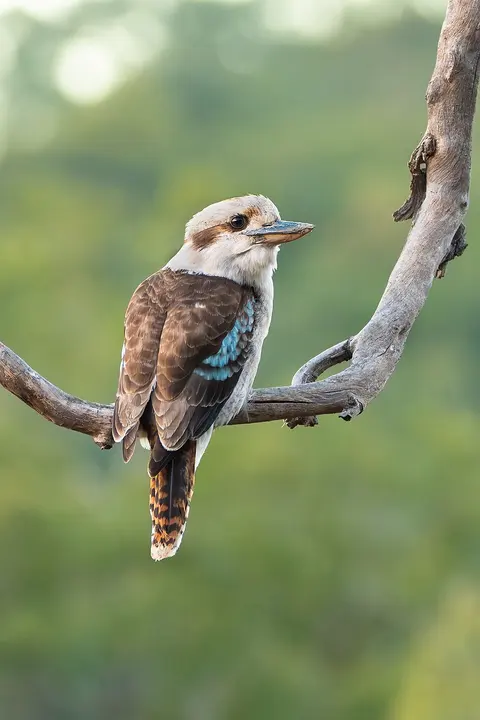
The laughing kookaburra is a bird in the kingfisher subfamily Halcyoninae. It is a large kingfisher with a whitish head and a brown eye-stripe. The upperparts are mostly dark brown but there is a mottled light-blue patch on the wing coverts.
The underparts are cream-white and the tail is barred with rufous and black. The plumage of the male and female birds is similar. The territorial call is a distinctive laugh that is often delivered by several birds at the same time, and is widely used as a stock sound effect in situations that involve a jungle setting. The laughing kookaburra is native to eastern mainland Australia, but has also been introduced to parts of New Zealand, Tasmania, and Western Australia. It occupies dry eucalypt forest, woodland, city parks and gardens. This species is sedentary and occupies the same territory throughout the year. It is monogamous, retaining the same partner for life.
Appearance
The laughing kookaburra is the largest species of kingfisher, outsizing even the giant kingfisher in body mass. It is a stout, stocky bird 41–47 cm (16–19 in) in length, with a large head, prominent brown eyes, and a long and robust bill. The sexes are very similar, although the female is usually larger and has less blue to the rump than the male. The male weighs 196–450 g (6.9–15.9 oz), mean 307 g (10.8 oz) and the female 190–465 g (6.7–16.4 oz), mean 352 g (12.4 oz).
Behaviour
Kookaburras occupy woodland territories (including forests) in loose family groups, and their laughter serves the same purpose as a great many other bird calls—to mark territorial borders. Most species of kookaburras tend to live in family units, with offspring helping the parents hunt and care for the next generation of offspring.
Diet
Kookaburras hunt much as other kingfishers (or indeed Australasian robins) do, by perching on a convenient branch or wire and waiting patiently for prey to pass by. Common prey include mice and similar-sized small mammals, a large variety of invertebrates (such as insects, earthworms and snails), yabbies, small fish, lizards, frogs, small birds and nestlings, and most famously, snakes.
Habitat
The laughing kookaburra is native to eastern Australia and has a range that extends from the Cape York Peninsula in the north to Cape Otway in the south. It is present on both the eastern and the western sides of the Great Dividing Range. In the south the range extends westwards from Victoria to the Yorke Peninsula and the Flinders Ranges in South Australia. It has been introduced into many other areas probably because of its reputation for killing snakes.
Where the Laughing kookaburra lives
Recorded in Ashmore and Cartier Is. (Oceania).
Most records fall in New South Wales, Queensland, Victoria, Western Australia, Tasmania and Australian Capital Territory.
See the Laughing kookaburra’s range on the globe
Conservation status
Least concern (LC). Not at risk: it is doing well in the wild. Categories are the IUCN Red List as republished by GBIF.
Sources
The range is a density of 1,309,378 georeferenced GBIF records, shown on the continents where it is mainly recorded, not an expert-drawn map. Description from Wikipedia.