Animals / Mammal
Lar gibbon
Hylobates lar · Hylobatidae
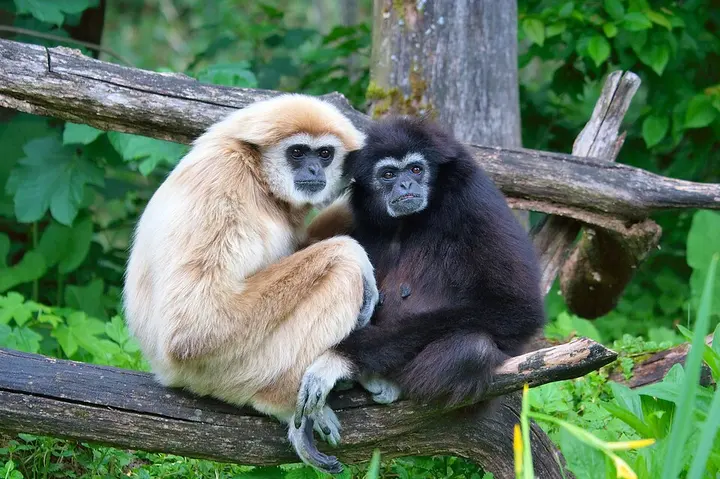
The lar gibbon, also known as the white-handed gibbon, is an endangered primate in the gibbon family, Hylobatidae. It is one of the better-known gibbons and is often kept in captivity.
Appearance
The fur coloring of the lar gibbon varies from black and dark-brown to light-brown, sandy colors. The hands and feet are white-colored, likewise a ring of white hair surrounds the black face. Both males and females can be all color variants, and the sexes also hardly differ in size. Gibbons are true brachiators, propelling themselves through the forest by swinging under the branches using their arms.
Behaviour
Lar gibbons are diurnal and arboreal, inhabiting rain forests. Lar gibbons are usually active for an average of 8.7 hours per day, leaving their sleeping sites right around sunrise and entering sleeping trees an average of 3.4 hours before sunset.
Habitat
Lar gibbons have the greatest north-south range of any of the gibbon species. They are found in Indonesia, Laos, Malaysia, Myanmar and Thailand. Their range historically extended from southwest China to Thailand and Burma south to the whole Malay Peninsula in primary and secondary tropical rain forests. It is also present in the northwest portion of the island of Sumatra. In recent decades, especially, the continental range has been reduced and fragmented.
Life cycle
Sexually, they are similar to other gibbons. Mating occurs in every month of the year, but most conceptions occur during the dry season in March, with a peak in births during the late rainy season, in October. On average, females reproduce for the first time at about 11 years of age in the wild, much later than in captivity. Gestation is six months long on average, and pregnancies are usually of a single young.
Where the Lar gibbon lives
Recorded in Thailand, Malaysia, Indonesia and Myanmar (Asia).
Most records fall in Phetchaburi, Nakhon Ratchasima, Nakhon Nayok, Chiang Mai, Prachin Buri and Sumatera Utara.
See the Lar gibbon’s range on the globe
Conservation status
Endangered (EN). In danger of dying out in the wild. Categories are the IUCN Red List as republished by GBIF.
Sources
The range is a density of 1,904 georeferenced GBIF records, shown on the continents where it is mainly recorded, not an expert-drawn map. Description from Wikipedia.