Animals / Reptile
Komodo dragon
Varanus komodoensis · Varanidae
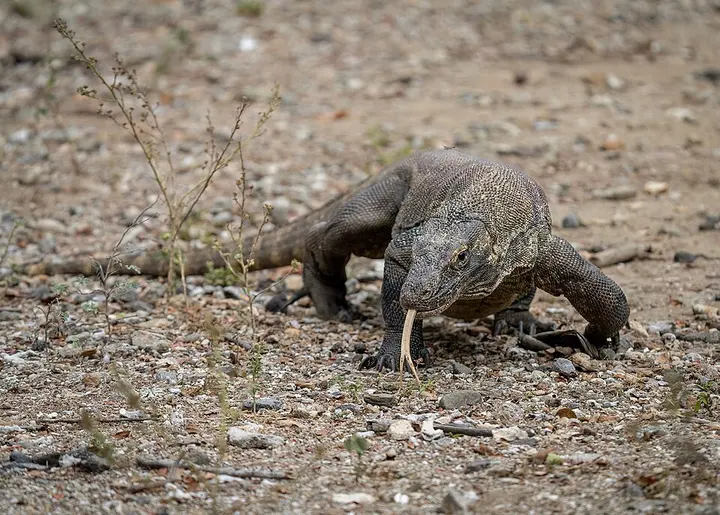
The Komodo dragon, also known as the Komodo monitor, is a large reptile of the monitor lizard family Varanidae that is endemic to the Indonesian islands of Komodo, Rinca, Flores, Gili Dasami, and Gili Motang. The largest extant population lives within the Komodo National Park in Eastern Indonesia. It is the largest extant species of lizard, with the males growing to a maximum length of 3 m (10 ft) and weighing up to 150 kg (330 lb).
As a result of their size, which is exceptional among reptiles, Komodo dragons are apex predators, dominating the ecosystems in which they live. Komodo dragons hunt and ambush prey; juveniles take small prey like invertebrates or birds, and adults favour larger mammals, occasionally even attacking humans. The diet of adult Komodo dragons mainly consists of Javan rusa and feral pigs, though they also eat considerable amounts of carrion. Young Komodo dragons are vulnerable and dwell in trees to avoid predators, including cannibalistic adults, which young Komodo dragons also try to repel by rolling in feces. They take 8 to 11 years to mature and are estimated to live up to 30 years (or by some estimates as much as 62 years).
Appearance
In the wild, adult Komodo dragons usually weigh around 70 kg (150 lb), although captive specimens often weigh more. According to Guinness World Records, an average adult male will weigh 79 to 91 kg (174 to 201 lb) and measure 2.59 m (8.5 ft), while an average female will weigh 68 to 73 kg (150 to 161 lb) and measure 2.29 m (7.5 ft).
Behaviour
The Komodo dragon prefers hot and dry places and typically lives in dry, open grassland, savanna, and tropical forest at low elevations. As an ectotherm, it is most active in the day, although it exhibits some nocturnal activity. Komodo dragons are solitary, coming together only to breed and eat. There are some "personality" differences among the species, where some present as more "shy", particularly females.
Diet
Komodo dragons are apex predators. They are carnivores; older views considered them as eating mostly carrion, but newer research has found they will frequently ambush live prey with a stealthy approach. When suitable prey arrives near a dragon's ambush site, it will suddenly charge at the animal at high speeds and go for the underside or the throat.
Life cycle
Mating occurs between May and August, with the eggs laid in September. During this period, males fight over females and territory by grappling with one another upon their hind legs, with the loser eventually being pinned to the ground. These males may vomit or defecate when preparing for the fight. The winner of the fight will then flick his long tongue at the female to gain information about her receptivity.
Where the Komodo dragon lives
Recorded in Indonesia (Asia).
Most records fall in Nusa Tenggara Timur and Jawa Timur.
See the Komodo dragon’s range on the globe
Conservation status
Endangered (EN). In danger of dying out in the wild. Categories are the IUCN Red List as republished by GBIF.
Sources
The range is a density of 1,214 georeferenced GBIF records, shown on the continents where it is mainly recorded, not an expert-drawn map. Description from Wikipedia.