Animals / Mammal
Kob
Kobus kob · Bovidae
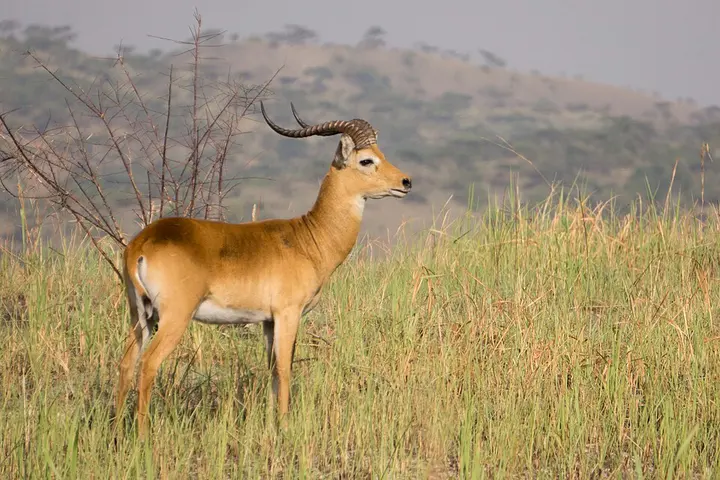
The kob is an antelope found across Central Africa and parts of West Africa and East Africa. Together with the closely related reedbucks, waterbucks, lechwe, Nile lechwe, and puku, it forms the Reduncinae tribe. Found along the northern savanna, it is often seen in Murchison Falls and Queen Elizabeth National Park, Uganda; Garamba and Virunga National Park, and the Democratic Republic of the Congo, as well as grassy floodplains of South Sudan.
Kob are found in wet areas (such as floodplains), where they eat grasses. Kob are diurnal, but inactive during the heat of the day. They live in groups of either females and calves or just males. These groups generally range from five to forty animals. Among the kobs of eastern Africa, the Ugandan kob (Kobus kob thomasi) appears on the coat of arms of Uganda, and white-eared kob (Kobus kob leucotis), found in South Sudan, southwest Ethiopia, and extreme northeast Uganda, participate in large-scale migrations.
Appearance
The kob resembles the impala but is more heavily built. Males are more robust than females and have horns. Males have shoulder heights of 90–100 cm (35–39 in) and an average weight of 94 kg (207 lb). Females have shoulder heights of 82–92 cm (32–36 in) and weigh on average 63 kg (139 lb). The pelage of the kob is typically golden to reddish-brown overall, but with the throat patch, eye ring, and inner ear being white, and the forelegs being black at the front.
Behaviour
The kob's distribution from western Africa to central East Africa is patchy. It inhabits flat areas and open country close to permanent water, with consistent climate. It drinks daily and requires fresh grazing. During the rains, kob frequent short grasses and keep them short. Since it is dependent on water, the kob does not wander far into arid areas. Kob gather on and move from one pasture to another, coinciding with seasonal changes.
Habitat
The kob is currently found in Benin, Burkina Faso, Cameroon, Central African Republic, Chad, Ivory Coast, Democratic Republic of the Congo, Ethiopia, Ghana, Guinea, Guinea Bissau, Mali, Mauritania, Niger, Nigeria, Senegal, South Sudan, Togo, and Uganda. It was formerly also found in Gambia, Kenya, Sierra Leone, Morocco and Tanzania, but is now extinct in those areas.
Where the Kob lives
Recorded in Benin, Uganda, Ghana and Dem. Rep. Congo (Africa).
Most records fall in Atakora, Borgou, Alibori, Ntoroko, Nwoya and Northern.
See the Kob’s range on the globe
Conservation status
Least concern (LC). Not at risk: it is doing well in the wild. Categories are the IUCN Red List as republished by GBIF.
Sources
The range is a density of 9,094 georeferenced GBIF records, shown on the continents where it is mainly recorded, not an expert-drawn map. Description from Wikipedia.