Animals / Mammal
Koala
Phascolarctos cinereus · Phascolarctidae
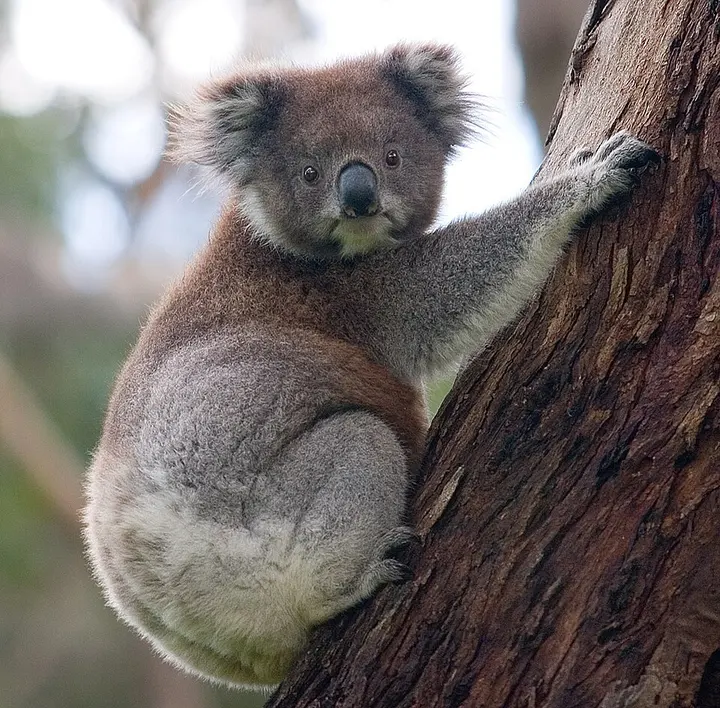
The koala, sometimes inaccurately called the koala bear, is an arboreal herbivorous marsupial native to Australia. It is the only extant representative of the family Phascolarctidae. Its closest living relatives are the wombats.
The koala is found in coastal areas of the continent's eastern and southern regions, inhabiting Queensland, New South Wales, Victoria, and South Australia. It is easily recognisable by its stout, tailless body and large head with round, fluffy ears and large, dark nose. The koala has a body length of 60–85 cm (24–33 in) and weighs 4–15 kg (8.8–33.1 lb). Its fur colour ranges from silver grey to chocolate brown. Koalas from the northern populations are typically smaller and lighter in colour than their counterparts further south. These populations are possibly separate subspecies, but not all researchers accept this. Koalas typically inhabit open Eucalyptus woodland, as the leaves of these trees make up most of their diet.
Appearance
The koala is a robust animal with a large head and vestigial or non-existent tail. It has a body length of 60–90 cm (24–35 in) and a weight of 4–15 kg (8.8–33.1 lb), making it among the largest arboreal marsupials. Koalas from Victoria are twice as heavy as those from Queensland. The species is sexually dimorphic: males are 50% larger than females. Males' noses are more curved and sport chest glands, which are visible as bald patches.
Behaviour
Koalas are herbivorous, and while most of their diet consists of eucalypt leaves, they can be found in trees of other genera, such as Acacia, Allocasuarina, Callitris, Leptospermum, and Melaleuca. Though the foliage of over 600 species of Eucalyptus is available, the koala shows a strong preference for around 30. They prefer plant matter with higher protein than fibre and lignin.
Habitat
The koala's range covers roughly 1,000,000 km2 (390,000 sq mi), and 30 ecoregions. They can be found in both tropical and temperate habitats ranging from dense woodlands to more spaced-out forests. In semi-arid climates, they prefer riparian habitats, where nearby streams and creeks provide refuge during times of drought and extreme heat.
Life cycle
Koalas are seasonal breeders, and they give birth from October to May. Females in oestrus lean their heads back and shake their bodies. Despite these obvious signals, males try to copulate with any female during this period, mounting them from behind. Because of his much larger size, a male can overpower a female. A female may scream and vigorously fight off her suitors but will accede to one that is dominant or familiar.
Where the Koala lives
Recorded in Ashmore and Cartier Is. (Oceania).
Most records fall in New South Wales, Queensland, Victoria and South Australia.
See the Koala’s range on the globe
Conservation status
Vulnerable (VU). At risk: it could become endangered. Categories are the IUCN Red List as republished by GBIF.
Sources
The range is a density of 359,617 georeferenced GBIF records, shown on the continents where it is mainly recorded, not an expert-drawn map. Description from Wikipedia.