Animals / Mammal
Kirk's dik-dik
Madoqua kirkii · Bovidae
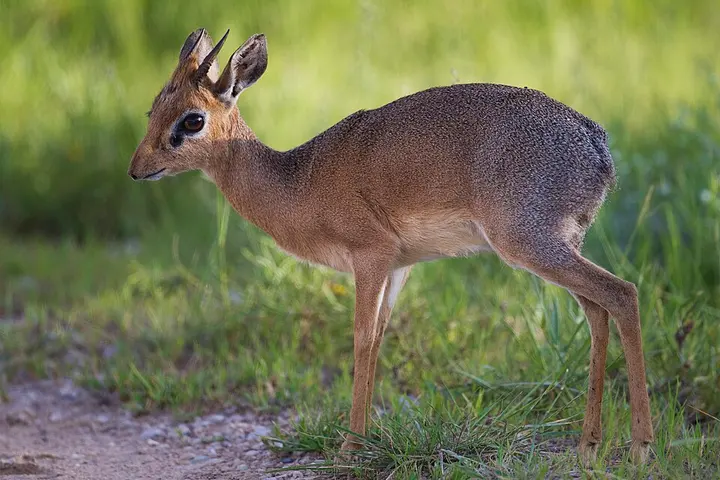
Kirk's dik-dik is a species of small dik-dik antelope native to Eastern and Southern Africa. It is believed to have six subspecies and possibly a seventh existing in southwest Africa. Dik-diks are herbivores, typically of a fawn color that aids in camouflaging themselves in savannah habitats.
It is also capable of reaching speeds up to 42 km/h (26 mph). The lifespan of Kirk's dik-dik in the wild is typically 5 years, but may surpass 10 years. In captivity, males have been known to live up to 16.5 years, while females have lived up to 18.4 years.
Appearance
Dik-diks are some of the world's smallest antelopes, with the largest, the Kirk's dik-dik, standing between 35–45 cm (14–18 in) tall and weighing 3.8–7.2 kg (8.4–15.9 lb). Female dik-diks tend to be 0.4–1 kg (0.88–2.20 lb) heavier than males. They are dainty creatures with a pointed, mobile snout, large eyes and ears, prominent preorbital glands, pipestem legs, hare-like hind limbs that are significantly larger than their forelimbs, and a vestigial tail.
Diet
Dik-diks are herbivorous and their diets consist mainly of foliage, fruits, shoots, and berries. Due to their adaptations, dik-diks are water-independent and rely on vegetation as a source of water. Kirk's dik-diks are concentrate selectors, feeding selectively on dicotyledonous plants that can be rapidly fermented and digested. This includes leaves and fruit high in nutrients and water, but low in fiber and cellulose.
Where the Kirk's dik-dik lives
Recorded in Kenya, Namibia and Tanzania (Africa).
Most records fall in Coast, Oshikoto, Otjozondjupa, Eastern, Rift Valley and Erongo.
See the Kirk's dik-dik’s range on the globe
Conservation status
Least concern (LC). Not at risk: it is doing well in the wild. Categories are the IUCN Red List as republished by GBIF.
Sources
The range is a density of 2,501 georeferenced GBIF records, shown on the continents where it is mainly recorded, not an expert-drawn map. Description from Wikipedia.