Animals / Reptile
King cobra
Ophiophagus hannah · Elapidae
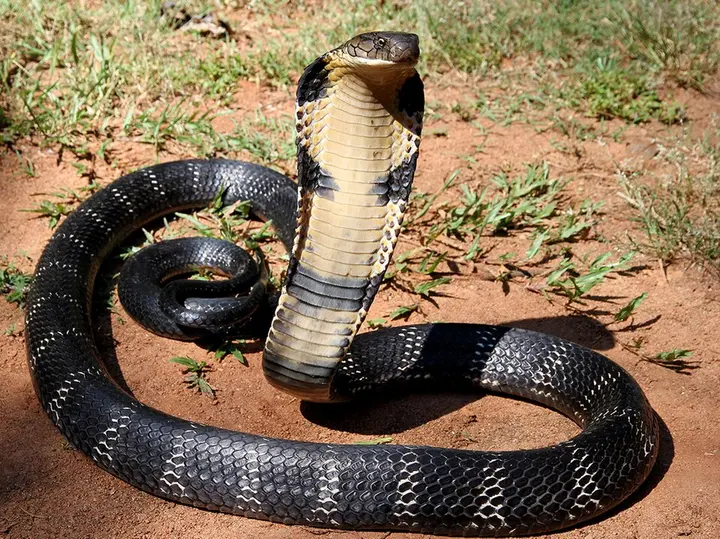
The king cobra is a species complex of snakes endemic to Asia. With an average length of 3.18 to 4 m and a record length of 5.85 m (19.2 ft), it is the world's longest venomous snake and among the heaviest. Under the genus Ophiophagus, it is not phylogenetically a true cobra despite its common name and some resemblance.
Spanning from the Indian subcontinent through Southeastern Asia to Southern China, the king cobra is widely distributed albeit not commonly seen. Individuals have diversified colouration across its habitats, from black with white strips to unbroken brownish grey, although after taxonomic re-evaluation, it is no longer the sole member of its genus but is now a species complex; these differences in pattern and other aspects may cause the genus to be split into at least four species, spread across its large geographic range. It chiefly hunts other snakes, including those of its own kind, although other lizards and rodents are also occasional prey.
Appearance
The king cobra's skin is olive green with black and white bands on the trunk that converge to the head. The head is covered by 15 drab-coloured and black-edged shields (large scales consistently present between individuals). The muzzle is rounded, and the tongue black. It has two fangs and 3–5 maxillary teeth in the upper jaw, and two rows of teeth in the lower jaw. The nostrils are between two shields. The large eyes have a golden iris and round pupils.
Behaviour
Like other snakes, a king cobra receives chemical information via its forked tongue, which picks up scent particles and transfers them to a sensory receptor (Jacobson's organ) located in the roof of its mouth. Following envenomation, it swallows its prey whole. Because of its flexible jaws, it can swallow prey much larger than its head. It is considered diurnal because it hunts during the day, but has also been seen at night, albeit rarely.
Diet
The king cobra is an apex predator and dominant over all other snakes except large pythons. Its diet consists primarily of other snakes and lizards, including varanids, Indian cobra, banded krait, Oriental rat snake, reticulated pythons, green whip snake, Himalayan keelback, banded wolf snake and Blyth's reticulated snake. It also hunts Malabar pit viper and hump-nosed pit viper by following their odour trails. In Singapore, one was observed swallowing a clouded monitor.
Habitat
The king cobra has a wide distribution throughout tropical Asia. It occurs in elevations of 2,000 m (6,600 ft) from the Terai in India and southern Nepal to the Brahmaputra River basin in Bhutan and northeast India, down to Bangladesh, Myanmar, southern China, Cambodia, Thailand, Laos, Vietnam; to the maritime Southeast Asian countries of Malaysia, Singapore, Indonesia and the Philippines.
Where the King cobra lives
Recorded in India, China, Thailand, Hong Kong, Vietnam, Philippines and Bhutan (Asia).
Most records fall in Karnataka, Guangdong, Phetchaburi, Islands, Assam and Yunnan.
See the King cobra’s range on the globe
Conservation status
Vulnerable (VU). At risk: it could become endangered. Categories are the IUCN Red List as republished by GBIF.
Sources
The range is a density of 796 georeferenced GBIF records, shown on the continents where it is mainly recorded, not an expert-drawn map. Description from Wikipedia.