Animals / Bird
Killdeer
Charadrius vociferus · Charadriidae
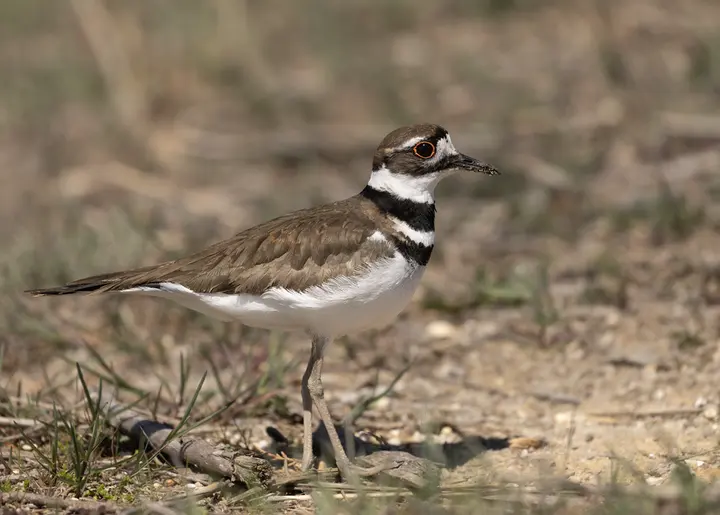
The killdeer is a large plover found in the Americas. Its shrill, two-syllable call is often heard, sounding like "kill deer". It was described and given its current scientific name in 1758 by Carl Linnaeus in the 10th edition of his Systema Naturae.
Three subspecies are described. Its upperparts are mostly brown with rufous fringes, the head has patches of white and black, and two black bands cross the breast. The belly and the rest of the breast are white. The nominate (or originally described) subspecies breeds from southeastern Alaska and southern Canada to Mexico. It is seen year-round in the southern half of its breeding range; the subspecies C. v. ternominatus is resident in the West Indies, and C. v. peruvianus inhabits Peru and surrounding South American countries throughout the year. North American breeders winter from their resident range south to Central America, the West Indies, and the northernmost portions of South America.
Appearance
The killdeer is a tall and slender plover, with a relatively long tail. Adults ranging in length from 20 to 28 cm (7.9 to 11.0 in), having a wingspan between 59 and 63 cm (23 and 25 in), and usually being between 72 and 121 g (2.5 and 4.3 oz) in weight. It has a short, thick, and dark bill, flesh-colored legs, and a red eye ring. Its upper parts are mostly brown with rufous fringes, its cap, back, and wings being the former color.
Behaviour
The killdeer forms pairs on its breeding grounds right after arriving. Both sexes (although the male more often than the female) advertise in flight with loud "killdeer" calls. The male also advertises by calling from a high spot, scraping out a dummy nest, and with killdeer flights, where it flies with slow wingbeats across its territory.
Diet
The killdeer feeds primarily on insects (especially beetles and flies), in addition to millipedes, worms, snails, spiders, and some seeds. It opportunistically takes tree frogs and dead minnows. It forages almost exclusively in fields (no matter the tide), especially those with short vegetation and with cattle (which likely shorten the vegetation) and standing water. Standing water alone does not have a significant effect on field choice unless combined with cattle.
Habitat
The nominate subspecies of the killdeer breeds in the US (including southeastern Alaska), southern Canada, and Mexico, with less widespread grounds further south, to Panama. Some northern populations are migratory. This bird is resident in the southern half of its breeding range, found throughout the year in most of the contiguous United States.
Where the Killdeer lives
Recorded in United States of America and Canada (North America).
Most records fall in California, Texas, Ontario, Ohio, Illinois and Florida.
See the Killdeer’s range on the globe
Conservation status
Near threatened (NT). Not at risk yet, but could be soon. Categories are the IUCN Red List as republished by GBIF.
Sources
The range is a density of 9,895,978 georeferenced GBIF records, shown on the continents where it is mainly recorded, not an expert-drawn map. Description from Wikipedia.