Animals / Amphibian
Japanese giant salamander
Andrias japonicus · Cryptobranchidae
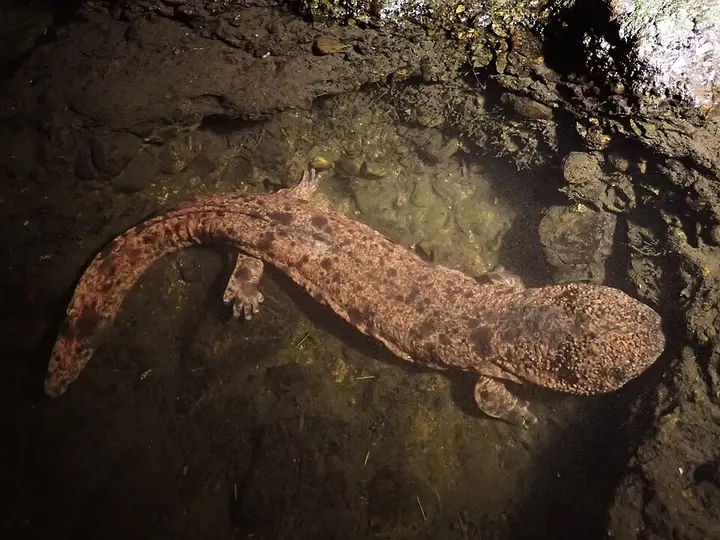
The Japanese giant salamander is a species of fully aquatic giant salamander endemic to Japan, occurring across the western portion of the main island of Honshu, with smaller populations present on Shikoku and in northern Kyushu. With a length of up to 5 feet (1.5 m), it is the third-largest salamander in the world, being surpassed only by the very similar and closely related Chinese giant salamander and the South China giant salamander.
It is known in Japanese as ōsanshōuo (オオサンショウウオ/大山椒魚), literally meaning "giant salamander". Other local names include hanzaki, hanzake, and ankou. This salamander was first catalogued by Europeans when the resident physician of Dejima Island in Nagasaki, Philipp Franz von Siebold, captured an individual and shipped it back to Leiden in the Netherlands, in the 1820s. The species was designated as a special natural monument in 1951, and is protected by the Central Government. It is one of only six species of giant salamanders in the world.
Appearance
The Japanese giant salamander can grow to a length of 5 ft (150 cm) and a weight of 55 lb (25 kg). The largest wild specimen on record weighed 58 lb (26.3 kg) and was 4.46 ft (136 cm) long. It is the third-largest amphibian in the world, only smaller than its close relatives, the South China giant salamander and the Chinese giant salamander. The brown and black mottled skin of A. japonicus provides camouflage against the bottoms of streams and rivers.
Behaviour
The Japanese giant salamander is restricted to streams with clear, cool water. Due to its large size and lack of gills, it is confined to flowing water where oxygen is abundant. It is entirely aquatic and almost entirely nocturnal.
Habitat
The Japanese giant salamander occurs in southwestern Japan (west of Gifu Prefecture in Honshu and parts of Shikoku and Kyushu). In particular, Okayama, Hyogo, Shimane, Tottori, Yamaguchi, Mie, Ehime, Gifu, and Ōita Prefectures are known to harbor its robust populations. They are typically found in fast-flowing mountain streams of these prefectures.
Life cycle
The Japanese giant salamander remains in bodies of water its entire life. During the mating season, typically in late August and early September, sexually mature males start actively finding suitable nesting sites and often migrate upstream into smaller sections of the river or its tributaries. Because of the limited availability of suitable nesting sites, only large and competitive males are able to occupy nesting sites and become den masters.
Where the Japanese giant salamander lives
Recorded in Japan (Asia).
Most records fall in Tottori, Kyōto, Hyōgo, Gifu, Okayama and Ōsaka.
See the Japanese giant salamander’s range on the globe
Conservation status
Vulnerable (VU). At risk: it could become endangered. Categories are the IUCN Red List as republished by GBIF.
Sources
The range is a density of 295 georeferenced GBIF records, shown on the continents where it is mainly recorded, not an expert-drawn map. Description from Wikipedia.