Animals / Mammal
Indri
Indri indri · Indriidae
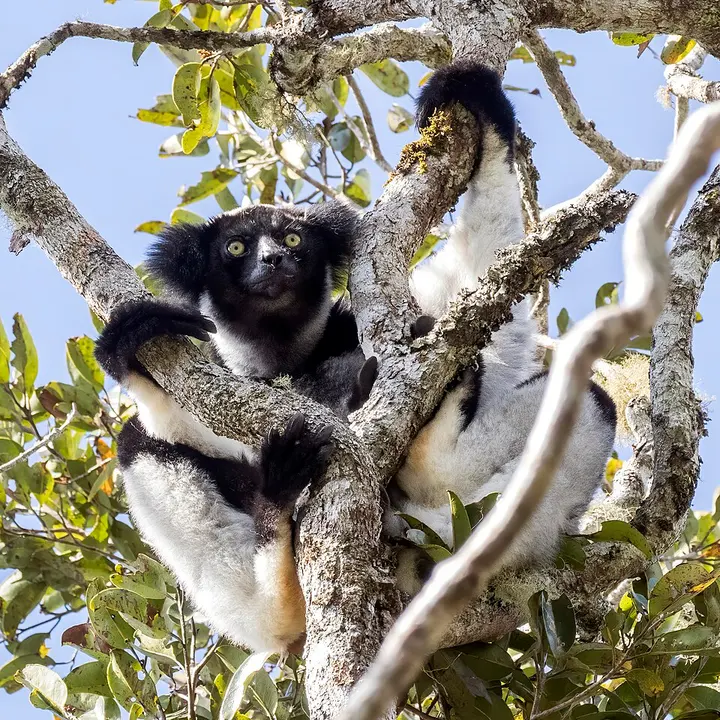
The indri, also called the babakoto, is one of the largest living lemurs, with a head-body length of about 64–72 cm and a weight of between 6 and 9.5 kg. It has a black and white coat and maintains an upright posture when climbing or clinging. It is monogamous and lives in small family groups, moving through the canopy, and is herbivorous, feeding mainly on leaves but also seeds, fruits, and flowers.
The groups are quite vocal, communicating with other groups by singing, roaring and other vocalisations. It is a diurnal tree-dweller related to the sifakas and, like all lemurs, it is native to Madagascar. It is revered by the Malagasy people and plays an important part in their myths and legends with various stories in existence accounting for its origin. The main threats faced by the indri are habitat destruction and fragmentation due to slash and burn agriculture, fuelwood gathering, and logging. It is also hunted despite taboos against this. The International Union for Conservation of Nature has rated its conservation status as "critically endangered".
Appearance
Along with the diademed sifaka, the indri is the largest lemur still in existence; both have average weights of about 6.5 kg. It can weigh up to 9.0 kg (19+3⁄4 lb) to 9.5 kg (21 lb) and perhaps up to 15 kg (33 lb). It has a head-body length of 64–72 cm (2 ft 1 in – 2 ft 4+1⁄2 in) and can reach nearly 120 cm (4 ft) with legs fully extended. The indri is a vertical clinger and leaper and thus holds its body upright when traveling through trees or resting in branches.
Behaviour
The indri practices long-term monogamy, seeking a new partner only after the death of a mate. It lives in small groups consisting of the mated male and female and their maturing offspring. In the more fragmented forests of their range, the indri may live in larger groups with several generations. Habitat fragmentation limits the mobility and capacity of these large groups to break into smaller units. Like many other species of lemur, indri live in a female dominant society.
Diet
The indri is herbivorous and primarily folivorous. It prefers young, tender leaves, but will also eat seeds, fruits, and flowers. Female indri seem to have greater preference for immature leaves than males do and spend more time foraging among them. A wide variety of plant species are consumed, with members of the laurel family featuring prominently in the diet. The indri consumes little nontree vegetation.
Habitat
This lemur inhabits the lowland and montane forests along the eastern coast of Madagascar, from the Réserve Spéciale d'Anjanaharibe-Sud in the north to the Mangoro River in the south. They are absent from the Masoala Peninsula and the Marojejy National Park, even though both regions are connected to forests where indri do occur less than 40 km away.
Where the Indri lives
Recorded in Madagascar (Africa).
Most records fall in Atsinanana, Alaotra-Mangoro, Analamanga, Analanjirofo, Itasy and Bongolava.
See the Indri’s range on the globe
Conservation status
Critically endangered (CR). In very great danger of dying out in the wild. Categories are the IUCN Red List as republished by GBIF.
Sources
The range is a density of 2,618 georeferenced GBIF records, shown on the continents where it is mainly recorded, not an expert-drawn map. Description from Wikipedia.