Animals / Mammal
Indian rhinoceros
Rhinoceros unicornis · Rhinocerotidae
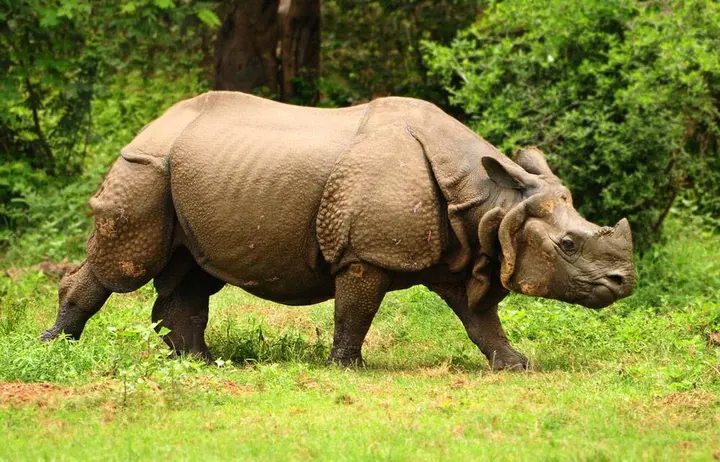
The Indian rhinoceros, also known as the greater one-horned rhinoceros, great Indian rhinoceros or Indian rhino, is a rhinoceros species native to the Indian subcontinent. It is the second largest living rhinoceros and the largest in Asia, with adult males weighing 2.07–2.2 t and adult females 1.6 t. Its thick skin is grey-brown with pinkish skin folds.
It has a single horn on its snout that grows up to 57.2–61.6 cm (22.5–24.3 in) long. Its upper legs and shoulders are covered in wart-like bumps, and it is nearly hairless aside from the eyelashes, ear fringes and tail brush. The Indian rhinoceros occurs in the Indo-Gangetic Plain in 12 protected areas in northern India and southern Nepal. It is a grazer, eating mainly grass, but also twigs, leaves, branches, shrubs, flowers, fruits and aquatic plants. It is a largely solitary animal, only associating in the breeding season and when rearing calves. Females give birth to a single calf after a gestation of 15.7 months. The birth interval is 34–51 months. Captive individuals can live up to 47 years.
Appearance
The Indian rhinoceros has a thick grey-brown skin with pinkish skin folds and one horn on its snout. Its upper legs and shoulders are covered in wart-like bumps. It has very little body hair, aside from eyelashes, ear fringes and tail brush. Bulls have huge neck folds. The skull is heavy with a basal length above 60 cm (24 in) and an occiput above 19 cm (7.5 in).
Behaviour
Bulls are usually solitary. Groups consist of cows with calves, or of up to six subadults. Such groups congregate at wallows and grazing areas. They are foremost active in early mornings, late afternoons and at night, but rest during hot days. They bathe regularly. The folds in their skin trap water and hold it even when they exit wallows. They are excellent swimmers and can run at speeds of up to 55 km/h (34 mph) for short periods.
Diet
The Indian rhino is a grazer. Its diet consists almost entirely of grasses (such as Arundo donax, Bambusa tulda, Cynodon dactylon, and Oryza sativa), but it also eat leaves, twigs and branches of shrubs and trees such as Lagerstroemia indica, flowers, fruits such as Ficus religiosa, and submerged and floating aquatic plants. It feeds in the mornings and evenings.
Habitat
Indian rhinos once ranged across the entire northern part of the Indian subcontinent, along the Indus, Ganges and Brahmaputra River basins, from Pakistan to the Indian-Myanmar border, including Bangladesh and the southern parts of Nepal and Bhutan. They may have also occurred in Myanmar, southern China and Indochina. They inhabit the alluvial grasslands of the Terai and the Brahmaputra basin.
Where the Indian rhinoceros lives
Recorded in Nepal and India (Asia).
Most records fall in Narayani, Assam, Bheri, Uttar Pradesh, Lumbini and West Bengal.
See the Indian rhinoceros’s range on the globe
Conservation status
Vulnerable (VU). At risk: it could become endangered. Categories are the IUCN Red List as republished by GBIF.
Sources
The range is a density of 1,400 georeferenced GBIF records, shown on the continents where it is mainly recorded, not an expert-drawn map. Description from Wikipedia.