Animals / Bird
Indian peafowl
Pavo cristatus · Phasianidae
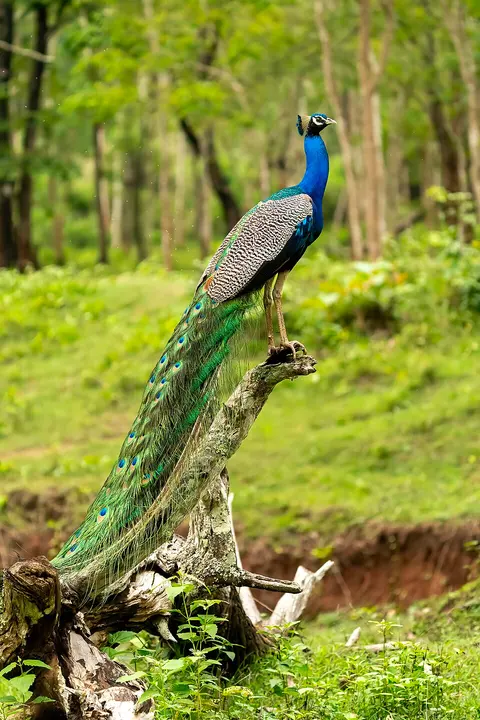
The Indian peafowl, also known as the common peafowl, or blue peafowl, is a species of peafowl native to the Indian subcontinent. While it originated in the Indian subcontinent, it has since been introduced to many other parts of the world. Male peafowl are referred to as peacocks, and female peafowl are referred to as peahens, although both sexes are often referred to colloquially as a "peacock".
The Indian peafowl displays a marked form of sexual dimorphism. The brightly coloured male has a blue coloured head with a fan-shaped crest and is best known for his long train. The train is made up of elongated upper-tail covert feathers with colourful eyespots. These stiff feathers are raised into a fan and quivered in a display during courtship. The peahen is predominantly brown in colour, with a white face and iridescent green lower neck, and lacks the elaborate train. There are several colour mutations of the Indian peafowl including the leucistic white peafowl. Despite the length and size of the covert feathers, the peacock is still capable of flight.
Appearance
The Indian peafowl's size, color and shape of the crest make them easily identifiable within their native distribution range. It displays a marked form of sexual dimorphism. A male peafowl or peacock is a larger sized bird with an average bill to tail length of 100–120 cm (40–46 in) and as much as 200–230 cm (78–90 in) to the end of a fully grown train. It weighs 4.1–5.2 kg (9–11.5 lb) and is amongst the heaviest birds in Phasianidae.
Behaviour
The Indian peafowl forages on the ground in small groups, known as musters, that usually have a single peacock and three to five peahens. After the breeding season, the flocks tend to be made up only of females and young. It is found in the open early in the mornings and tends to rest under cover during the heat of the day. It is often sighted dust-bathing at dusk. It roosts on tall trees at night, but may sometimes make use of rocks or buildings.
Diet
The Indian peafowl is found lazily feeding in the open early in the mornings, and might move to cultivated lands to feed during the mornings and the evenings. The groups often walk in single file to the nearby waterholes for a drink. The birds often congregate near human habitats and might be fed by humans. It is omnivorous and feeds on grass, seeds, flowerbuds, fruits, insects, and small reptiles. Around human settlements, it feeds on food scraps and even human excreta.
Habitat
The Indian peafowl is a resident breeder in the Indian subcontinent and is found across most of India and Sri Lanka. In India, it is found across the country from the Indus valley in the north-west to Assam in the north-east, and from Himalayas in the north to the southern tip, except for the marshlands of Sunderbans in East India. In India, it is found up to elevations of 5,000 ft (1,500 m) in the north and upto 6,000 ft (1,800 m) in the mountains of the south.
Where the Indian peafowl lives
Recorded in India and Sri Lanka (Asia and North America).
Introduced, not native, in United States of America.
Most records fall in Karnataka, Tamil Nadu, Kerala, Gujarat, Madhya Pradesh and Rajasthan.
See the Indian peafowl’s range on the globe
Conservation status
Least concern (LC). Not at risk: it is doing well in the wild. Categories are the IUCN Red List as republished by GBIF.
Sources
The range is a density of 668,157 georeferenced GBIF records, shown on the continents where it is mainly recorded, not an expert-drawn map. Description from Wikipedia.