Animals / Mammal
Indian flying fox
Pteropus medius · Pteropodidae
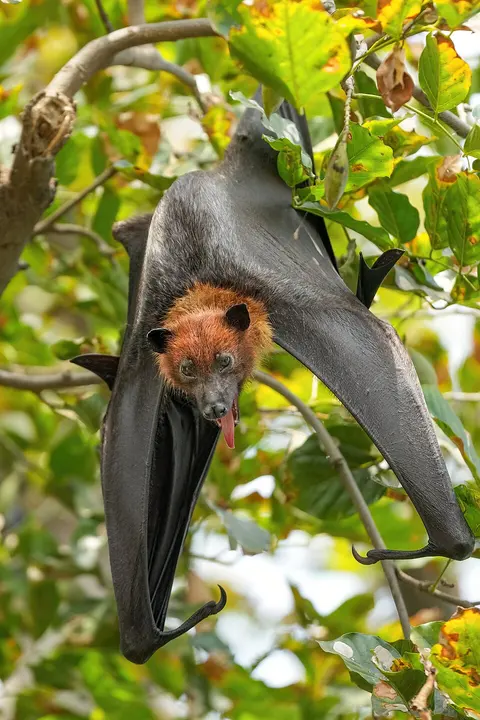
The Indian flying fox, also known as the greater Indian fruit bat, is a species of flying fox native to the Indian subcontinent. It is one of the largest bats in the world. It is of interest as a disease vector, as it is capable of transmitting several viruses to humans.
It is nocturnal and feeds mainly on ripe fruits, such as mangoes and bananas, and nectar. This species is often regarded as vermin due to its destructive tendencies towards fruit farms, but the benefits of its pollination and seed propagation often outweigh the impacts of its fruit consumption.
Appearance
The Indian flying fox is India's largest bat, and one of the largest bats in the world, weighing up to 1.6 kg (3.5 lb). Its body mass ranges from 0.6–1.6 kg (1.3–3.5 lb), and males are generally larger than females. The wingspan ranges from 1.2–1.5 m (3 ft 11 in – 4 ft 11 in) and body length averages 15.5–22.0 cm (6.1–8.7 in). The wings rise from the side of the dorsum and from the back of the second toe, and its thumb has a powerful claw.
Behaviour
The Indian flying fox roosts communally in the treetops of large trees in camps often with thousands of bats. Roosts tend to be used for upwards of ten years, and are usually inhabited year-round rather than seasonally. Within the roost the bats quarrel and chatter often, and during sunny hours of the day bats fan their wings and call, and during cloudy periods bats are silent and wrap their wings around their body.
Diet
The Indian flying fox is frugivorous or nectarivorous: it eats fruits and blossoms, and it drinks nectar from flowers. At dusk, it forages for ripe fruit. It is a primarily generalist feeder, and eats any available fruits, including guava, mangoes, and figs. Seeds from ingested fruits are scarified in its digestive tract and dispersed through its waste.
Habitat
The Indian flying fox is found across the Indian subcontinent, including in Bangladesh, Bhutan, India, Tibet, the Maldives, Myanmar, Nepal, Pakistan and Sri Lanka. It roosts in large, established colonies on open tree branches, especially in urban areas or in temples. It prefers to roost on tall trees with small diameters, especially canopy trees, and prefers to be in close proximity to bodies of water, human residences, and agricultural land.
Life cycle
The Indian flying fox is a polygynandrous species, and breeds yearly from July to October. Births occur from February to May. Gestation period is typically 140 to 150 days. The average birth number is 1 to 2 pups. Among members of the genus Pteropus, pups are carried by the mother for the first few weeks of life, with weaning occurring around 5 months of age. Males do not participate in parental care. Young bats learn to fly at approximately 11 weeks of age.
Where the Indian flying fox lives
Recorded in India, Sri Lanka, Maldives, Nepal and Bangladesh (Asia and Seven seas (open ocean)).
Most records fall in Kerala, Karnataka, Mahanuvara, Maharashtra, Tamil Nadu and Rajasthan.
See the Indian flying fox’s range on the globe
Conservation status
Near threatened (NT). Not at risk yet, but could be soon. Categories are the IUCN Red List as republished by GBIF.
Sources
The range is a density of 3,685 georeferenced GBIF records, shown on the continents where it is mainly recorded, not an expert-drawn map. Description from Wikipedia.