Animals / Reptile
Indian cobra
Naja naja · Elapidae
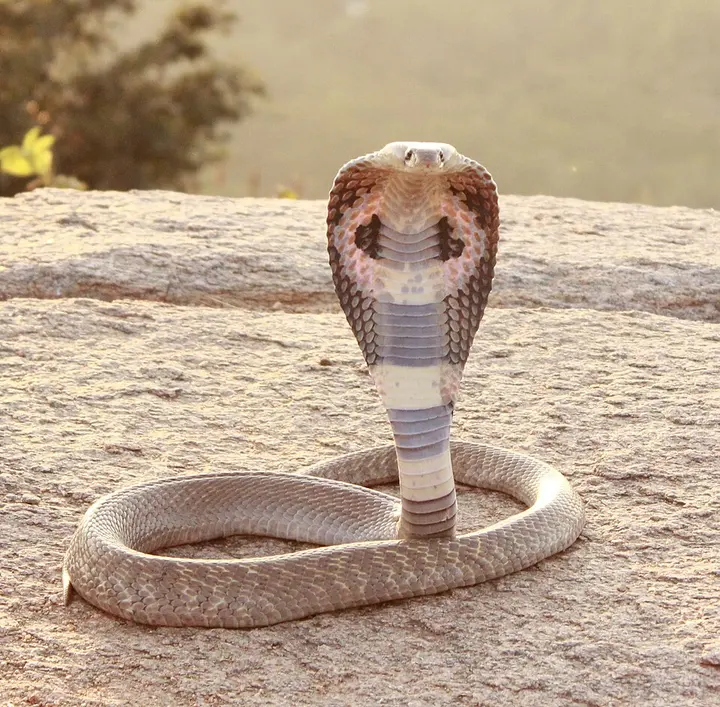
The Indian cobra, also known commonly as the spectacled cobra, Asian cobra, or binocellate cobra, is a species of cobra, a venomous snake in the family Elapidae. The species is native to the Indian subcontinent, and is a member of the "Big Four" species that are responsible for the most snakebite cases in Sri Lanka and India.
The Indian cobra is revered in Hindu mythology and culture, and is often seen with snake charmers. It is a protected species under the Indian Wildlife Protection Act (1972).
Appearance
The Indian cobra is a moderately sized, heavy-bodied species. This cobra species can easily be identified by its relatively large hood, which it expands when threatened. Many specimens exhibit a hood mark. This hood mark is located at the rear (dorsal surface) of the Indian cobra's hood. When the hood mark is present, it consists of two circular ocelli patterns connected by a curved line, evoking the image of spectacles.
Diet
The Indian cobra feeds on rodents, plovers, grebes, lizards and frogs. It bites quickly, and then waits while its venom damages the nervous system of the prey, paralyzing and often killing it. Like all snakes, N. naja swallows its prey whole. This species sometimes enters buildings in search of rodent prey.
Habitat
The Indian cobra is native to the Indian subcontinent and can be found throughout India, Pakistan, Sri Lanka, Bangladesh, and southern Nepal. In India, it may or may not occur in the state of Assam, some parts of Kashmir, and it does not occur at high altitudes of over 2,000 metres (6,600 ft) and in extreme desert regions. In Pakistan, it is absent in most of Balochistan province, parts of Khyber Pakhtunkhwa Province, desert areas elsewhere and the Northern Areas.
Life cycle
The Indian cobra is oviparous, laying eggs in the months of April through July. The female usually lays between 10 and 30 eggs in rat holes or termite mounds, which hatch 48 to 69 days later. Each hatchling measures 20–30 cm (8–12 in) in total length (tail included). The hatchlings are independent from birth and have fully functional venom glands.
Where the Indian cobra lives
Recorded in India, Sri Lanka and Thailand (Asia).
Most records fall in Maharashtra, Karnataka, Odisha, Tamil Nadu, Gujarat and Kerala.
See the Indian cobra’s range on the globe
Conservation status
Least concern (LC). Not at risk: it is doing well in the wild. Categories are the IUCN Red List as republished by GBIF.
Sources
The range is a density of 2,037 georeferenced GBIF records, shown on the continents where it is mainly recorded, not an expert-drawn map. Description from Wikipedia.