Animals / Mammal
Impala
Aepyceros melampus · Bovidae
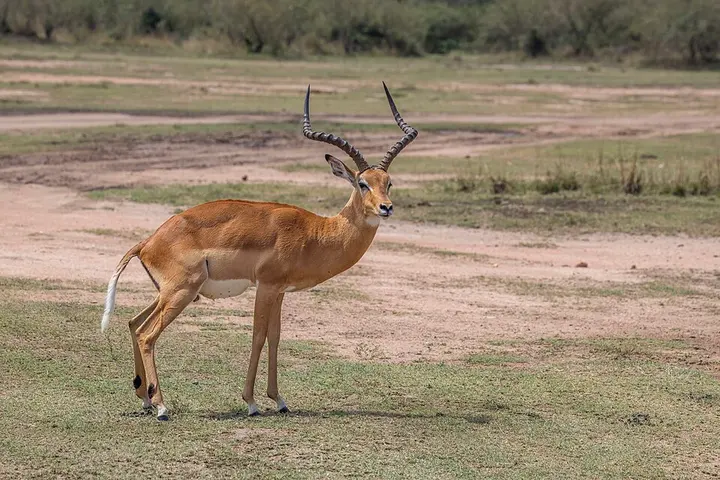
The impala or rooibok is a medium-sized antelope found in eastern and southern Africa. The only extant member of the genus Aepyceros, and tribe Aepycerotini, it was first described to Europeans by German zoologist Hinrich Lichtenstein in 1812. Two subspecies are recognised—the grassland-dwelling common impala, and the larger and darker black-faced impala, which lives in slightly more arid, scrubland environments.
The impala reaches 70–92 cm (28–36 in) at the shoulder and weighs 40–65 kg (88–143 lb). It features a glossy, reddish brown coat. The male's slender, lyre-shaped horns are 45–92 cm (18–36 in) long. Active mainly during the day, the impala may be gregarious or territorial depending upon the climate and geography. Three distinct social groups can be observed: the territorial males, bachelor herds and female herds. The impala is known for two characteristic leaps that constitute an anti-predator strategy. Browsers as well as grazers, impala feed on monocots, dicots, forbs, fruits and acacia pods (whenever available). An annual, three-week-long rut takes place toward the end of the wet season, typically in May.
Appearance
The impala is a medium-sized, slender-bodied antelope, comparable to the kob, puku and Grant's gazelle in size and build. The head-and-body length is around 130 centimetres (51 in). Males reach approximately 75–92 cm (30–36 in) at the shoulder, while females are 70–85 cm (28–33 in) tall. Males typically weigh 53–76 kilograms (117–168 lb) and females 40–53 kg (88–117 lb). Sexually dimorphic, females are hornless and smaller than males.
Behaviour
The impala is diurnal (active mainly during the day), though activity tends to cease during the hot midday hours; they feed and rest at night. Three distinct social groups can be observed – the territorial males, bachelor herds and female herds. The territorial males hold territories where they may form harems of females; territories are demarcated with urine and faeces and defended against juvenile or male intruders.
Diet
Impala browse as well as graze; either may predominate, depending upon the availability of resources. The diet comprises monocots, dicots, forbs, fruits and acacia pods (whenever available). Impala prefer places close to water sources, and resort to succulent vegetation if water is scarce.
Habitat
The impala inhabits woodlands due to its preference for shade; it can also be found on the interface (ecotone) between woodlands and savannahs. Places near water sources are preferred. In southern Africa, populations tend to be associated with Colophospermum mopane and Acacia woodlands. Habitat choices differ seasonally – Acacia senegal woodlands are preferred in the wet season, and A. drepanolobium savannahs in the dry season.
Where the Impala lives
Recorded in South Africa, Zambia, Kenya, Tanzania, Botswana, Namibia, Uganda and Zimbabwe (Africa).
Most records fall in Central, Mpumalanga, Rift Valley, Limpopo, KwaZulu-Natal and North-West.
See the Impala’s range on the globe
Conservation status
Least concern (LC). Not at risk: it is doing well in the wild. Categories are the IUCN Red List as republished by GBIF.
Sources
The range is a density of 25,461 georeferenced GBIF records, shown on the continents where it is mainly recorded, not an expert-drawn map. Description from Wikipedia.