Animals / Jellyfish
Immortal jellyfish
Turritopsis dohrnii · Oceaniidae
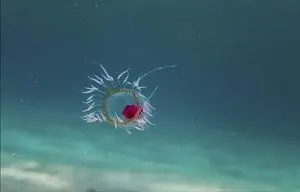
Turritopsis dohrnii, commonly known as the immortal jellyfish, is a species of small, biologically immortal Medusozoa (jellyfish) found worldwide in temperate to tropic waters. It is one of the few known cases of an animal capable of completely reverting to a sexually immature, sedentary polyps colonial stage after having reached sexual maturity as a solitary individual.
Like most other hydrozoans, T. dohrnii begin their lives as tiny, free-swimming larvae known as planulae. As a planula settles down, it gives rise to a colony of polyps that are attached to the sea floor. All the polyps and medusa arising from a single planula are clones. The polyps form into an extensively branched form, which is not commonly seen in most jellyfish. Jellyfish, also known as medusae, then bud off these polyps and continue their life in a free-swimming form, eventually becoming sexually mature. When sexually mature, they are known to prey on other jellyfish species at a rapid pace. If the T. dohrnii jellyfish is exposed to environmental stress, physical assault, or is sick or old, it can revert to the polyp stage, forming a new polyp colony.
Appearance
The medusa of Turritopsis dohrnii is bell-shaped made of mesoglea, with a maximum diameter of about 4.5 millimetres (0.18 in) and is about as tall as it is wide. The mesoglea in the walls of the bell is uniformly thin, except for some thickening at the apex. The relatively large stomach is bright red and has a cruciform shape in cross section.
Behaviour
Turritopsis dohrnii are a carnivorous species that commonly feed on zooplankton. Their diet mainly consists of plankton, fish eggs and small mollusks. T. dohrnii ingests food and excretes waste through the mouth. T. dohrnii hunts by using its tentacles as it drifts through the water. Its tentacles, which contain stinging cells called nematocysts, spread and sting its prey. The tentacles can then flex to direct its prey to the mouth.
Diet
Turritopsis dohrnii are a carnivorous species that commonly feed on zooplankton. Their diet mainly consists of plankton, fish eggs and small mollusks. T. dohrnii ingests food and excretes waste through the mouth. T. dohrnii hunts by using its tentacles as it drifts through the water. Its tentacles, which contain stinging cells called nematocysts, spread and sting its prey. The tentacles can then flex to direct its prey to the mouth.
Habitat
Turritopsis dohrnii was first discovered in the Mediterranean Sea but has since been found worldwide. T. dohrnii is generally found living in temperate to tropical waters. They can be found in marinas or docks, on vessel hulls, and on the ocean floor. They typically live in a salinity range of polyhaline (18–30 PSU) and euhaline (30–40 PSU).
Where the Immortal jellyfish lives
Recorded in Mexico, Spain, Italy, Egypt and United States of America (North America, Europe and Africa).
Most records fall in Veracruz, Baleares, Gerona, Castellón, Napoli and Al Isma`iliyah.
See the Immortal jellyfish’s range on the globe
Conservation status
Not evaluated (NE). Scientists haven’t checked yet how at risk it is, so this doesn’t mean it is safe or in danger. Categories are the IUCN Red List as republished by GBIF.
Sources
The range is a density of 41 georeferenced GBIF records, shown on the continents where it is mainly recorded, not an expert-drawn map. Description from Wikipedia.