Animals / Mammal
Humpback whale
Megaptera novaeangliae · Balaenopteridae
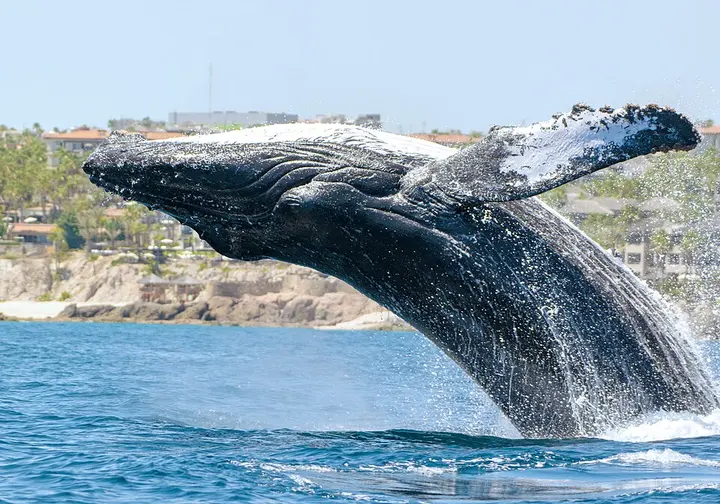
The humpback whale is a species of baleen whale. It is a rorqual and is the only species in the genus Megaptera. Adults range in length from 14–17 m (46–56 ft) and weigh up to 40 metric tons.
The humpback has a distinctive body shape, with long pectoral fins and tubercles on its head. It is known for breaching and other distinctive surface behaviors, making it popular with whale watchers. Males produce a complex song that typically lasts from 4 to 33 minutes. Found in oceans and seas around the world, humpback whales typically migrate between feeding areas towards the poles and breeding areas near the equator. Their diet consists mostly of krill and small fish, and they usually use bubbles to catch prey. They are polygynandrous breeders, with both sexes having multiple partners. Males will follow females and fight off rivals. Mothers give birth to calves in shallower water. Orcas are the main natural predators of humpback whales.
Appearance
The adult humpback whale is generally 14–15 m (46–49 ft) long, though individuals up to 16–17 m (52–56 ft) long have been recorded. Females are usually 1–1.5 m (3 ft 3 in – 4 ft 11 in) longer than males. The species can reach body masses of 40 metric tons (44 short tons). The longest recorded lengths were 17.4 m (57 ft) for a male and 18.6 m (61 ft) for a female. However, records for humpback whales measuring 17–18 m (56–59 ft) are considered unlikely.
Behaviour
Humpback whale groups, aside from mothers and calves, typically stay together for days or weeks at the most. They are normally sighted in small groups, though large aggregations form during feeding and among males competing for females. Humpbacks may interact with other cetacean species, such as right whales, fin whales, and bottlenose dolphins.
Diet
Humpback whales feed from spring to fall. They are generalist feeders; their main food items are krill, copepods, other plankton, and small schooling fish. The most common krill species eaten in the southern hemisphere is the Antarctic krill. Farther north, the northern krill and various species of Euphausia and Thysanoessa are consumed. Fish prey include herring, capelin, sand lances, and Atlantic mackerel.
Habitat
Humpback whales are found in marine waters worldwide, except for some areas at the equator and High Arctic and some enclosed seas. The farthest north they have been recorded is at 81°N around northern Franz Josef Land. They are usually coastal and tend to congregate in waters within continental shelves. Their winter breeding grounds are located around the equator; their summer feeding areas are found in colder waters, including near the polar ice caps.
Where the Humpback whale lives
Recorded in United States of America, Antarctica, Ashmore and Cartier Is., Canada, Mexico, Iceland, South Africa and Brazil (North America, Antarctica, Oceania, Europe, Africa and South America).
Most records fall in California, Alaska, Hawaii, Baja California Sur, British Columbia and Queensland.
See the Humpback whale’s range on the globe
Conservation status
Least concern (LC). Not at risk: it is doing well in the wild. Categories are the IUCN Red List as republished by GBIF.
Sources
The range is a density of 519,178 georeferenced GBIF records, shown on the continents where it is mainly recorded, not an expert-drawn map. Description from Wikipedia.