Animals / Bird
House sparrow
Passer domesticus · Passeridae
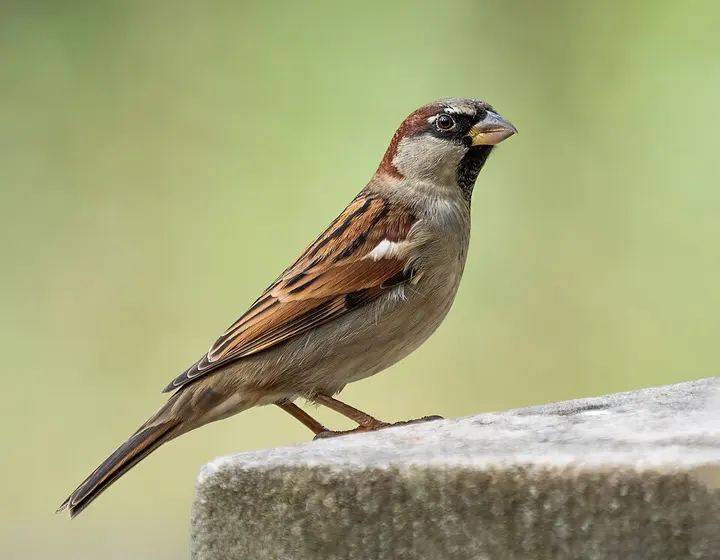
The house sparrow is a bird of the sparrow family Passeridae, found in most parts of the world. It is a small bird that has a typical length of 16 cm (6.3 in) and a mass of 24–39.5 g (0.85–1.39 oz). Females and young birds are coloured pale brown and grey, and males have brighter black, white, and brown markings.
One of 28 species in the genus Passer, the house sparrow is native to most of Europe, the Mediterranean Basin, and a large part of Asia. Its intentional or accidental introductions to many regions, including parts of Australasia, Africa, and the Americas, make it the most widely distributed wild bird. The house sparrow is strongly associated with human habitation, and can live in urban or rural settings. Though found in widely varied habitats and climates, it typically avoids extensive woodlands, grasslands, polar regions, and hot, dry deserts far away from human development. For sustenance, the house sparrow routinely feeds at home and public bird feeding stations, but naturally feeds on the seeds of grains, flowering plants and weeds.
Appearance
The house sparrow is typically about 16 cm (6.3 in) long, ranging from 14 to 18 cm (5.5 to 7.1 in). The house sparrow is a compact bird with a full chest and a large, rounded head. Its bill is stout and conical with a culmen length of 1.1–1.5 cm (0.43–0.59 in), strongly built as an adaptation for eating seeds. Its tail is short, at 5.2–6.5 cm (2.0–2.6 in) long. The wing chord is 6.7–8.9 cm (2.6–3.5 in), and the tarsus is 1.6–2.5 cm (0.63–0.98 in).
Behaviour
The house sparrow is a very social bird. It is gregarious during all seasons when feeding, often forming flocks with other species of birds. It roosts communally while breeding nests are usually grouped together in clumps. House sparrows also engage in social activities such as dust or water bathing and "social singing", in which birds call together in bushes. The house sparrow feeds mostly on the ground, but it flocks in trees and bushes.
Diet
As an adult, the house sparrow mostly feeds on the seeds of cereals and weeds, but it is opportunistic and adaptable, and eats whatever foods are available. In towns and cities, it often scavenges for food in garbage containers and congregates in the outdoors of restaurants and other eating establishments to feed on leftover food and crumbs.
Habitat
The house sparrow originated in the Middle East and spread, along with agriculture, to most of Eurasia and parts of North Africa. Since the mid-19th century, it has reached most of the world, chiefly due to deliberate introductions, but also through natural and shipborne dispersal.
Where the House sparrow lives
Recorded in Spain, France, United Kingdom, Netherlands, Germany, India, Portugal, Sweden and Norway (North America, Europe, Oceania and Asia).
Introduced, not native, in United States of America, Canada and Ashmore and Cartier Is..
Most records fall in New York, Texas, California, Illinois, Ontario and Pennsylvania.
See the House sparrow’s range on the globe
Conservation status
Least concern (LC). Not at risk: it is doing well in the wild. Categories are the IUCN Red List as republished by GBIF.
Sources
The range is a density of 25,883,672 georeferenced GBIF records, shown on the continents where it is mainly recorded, not an expert-drawn map. Description from Wikipedia.