Animals / Bird
House finch
Haemorhous mexicanus · Fringillidae
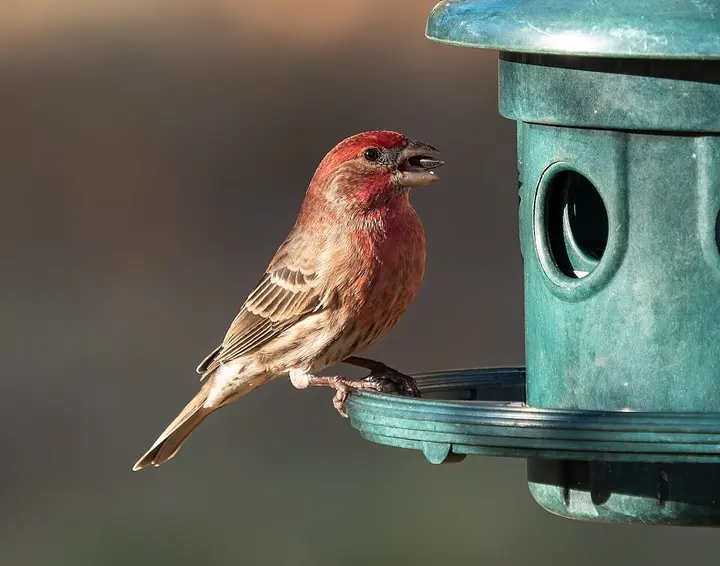
The house finch is a North American bird in the finch family. It is native to Mexico and southwestern United States, but has since been introduced to the eastern part of North America and Hawaiʻi, and is found year-round in almost all parts of the United States and most of Mexico, with breeding grounds well into Canada as far north as northern Alberta. There are estimated to be 40 million house finches across North America, making it the second-most populous finch, just behind the American goldfinch.
The house finch and the other two American rosefinches (Cassin's and purple finch) are placed in the genus Haemorhous.
Appearance
The house finch is a moderate-sized finch, 12.5 to 15 cm (5 to 6 in) long, with a wingspan of 20 to 25 cm (8 to 10 in). Body mass can vary from 16 to 27 g (9⁄16 to 15⁄16 oz), with an average weight of 21 g (3⁄4 oz). Among standard measurements, the wing chord is 7 to 8.4 cm (2+3⁄4 to 3+1⁄4 in), the tail is 5.7 to 6.5 cm (2+1⁄4 to 2+1⁄2 in), the culmen is 0.9 to 1.1 cm (3⁄8 to 7⁄16 in) and the tarsus is 1.6 to 1.8 cm (5⁄8 to 11⁄16 in).
Diet
House finches forage on the ground or in vegetation normally. They primarily eat grains, seeds and berries, being voracious consumers of weed seeds such as nettle and dandelion; included are incidental small insects such as aphids. They are frequent visitors to bird feeders throughout the year, particularly if stocked with sunflower or nyjer seed, and will congregate at hanging nyjer sock feeders.
Habitat
House finches are mainly permanent residents throughout their range; some birds migrate to the south, with adult females moving longer distances than males. Their breeding habitat is urban and suburban areas across North America, as well as various semi-open areas in the west from southern Canada to the Mexican state of Oaxaca; the population in central Chiapas may be descended from escaped cagebirds.
Life cycle
Nests are made in cavities, including openings in buildings, hanging plants, and other cup-shaped outdoor decorations. Sometimes nests abandoned by other birds are used. Nests may be re-used for subsequent broods or in following years. The nest is built by the female, sometimes in as little as two days. It is well made of twigs and debris, forming a cup shape, usually 1.8 to 2.7 m (5 ft 11 in to 8 ft 10 in) above the ground.
Where the House finch lives
Recorded in United States of America and Canada (North America).
Most records fall in California, Arizona, Pennsylvania, Colorado, Texas and New York.
See the House finch’s range on the globe
Conservation status
Least concern (LC). Not at risk: it is doing well in the wild. Categories are the IUCN Red List as republished by GBIF.
Sources
The range is a density of 19,241,568 georeferenced GBIF records, shown on the continents where it is mainly recorded, not an expert-drawn map. Description from Wikipedia.