Animals / Bird
Hooded vulture
Necrosyrtes monachus · Accipitridae
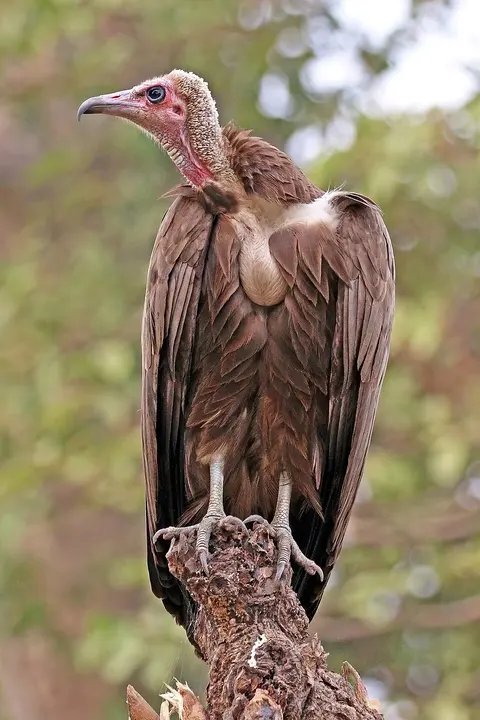
The hooded vulture is an Old World vulture in the order Accipitriformes, which also includes eagles, kites, buzzards and hawks. It is the only member of the genus Necrosyrtes, which is sister to the larger Gyps genus, both of which are a part of the Aegypiinae subfamily of Old World vultures. It is native to sub-Saharan Africa, where it has a widespread distribution with populations in southern, East and West Africa.
It is a scruffy-looking, small vulture with dark brown plumage, a long thin bill, bare crown, face and fore-neck, and a downy nape and hind-neck. Its face is usually a light red colour. It typically scavenges on carcasses of wildlife and domestic animals. Although it remains a common species with a stable population in the lower region of Casamance, some areas of The Gambia, and Guinea-Bissau, other regions such as Dakar, Senegal, show more than 85% losses in population over the last 50 years. Threats include poisoning, hunting, loss of habitat and collisions with electricity infrastructure, and the International Union for Conservation of Nature has rated its conservation status as "critically endangered" in their latest assessment (2022).
Appearance
The hooded vulture is a typical vulture, with a head that is usually pinkish-white, but flushes red when agitated, and a grey to black "hood". It has fairly uniform dark brown body plumage. It has broad wings for soaring and short tail feathers. This is one of the smaller Old World vultures. They are 62–72 cm (24–28 in) long, have a wingspan of 155–180 cm (61–71 in) and a body weight of 1.5–2.6 kg (3.3–5.7 lb).
Behaviour
Like other vultures hooded vultures are scavengers, feeding mostly from carcasses of dead animals and waste which they find by soaring over savanna and around human habitation, including waste tips and abattoirs. They do however also feed on insects, and conglomerate in large numbers during insect emergences, for example termite emergences where they associate with Steppe Eagles.
Habitat
Although hooded vultures have relatively small home ranges, they are widely distributed across Africa. It occurs in Senegal, Mauritania, Guinea-Bissau, The Gambia, Niger and Nigeria in West Africa; in East Africa it is found in Chad, Sudan, South Sudan, Ethiopia, Rwanda and Somalia; in southern Africa it has been recorded in northern Namibia, Botswana, Zambia, Zimbabwe, Mozambique and South Africa.
Where the Hooded vulture lives
Recorded in Gambia, South Africa, Ethiopia, Zimbabwe, Kenya, Ghana, Uganda, Senegal, Tanzania, Zambia and Botswana (Africa).
Most records fall in Mpumalanga, Banjul, Oromiya, West Coast, Limpopo and Rift Valley.
See the Hooded vulture’s range on the globe
Conservation status
Critically endangered (CR). In very great danger of dying out in the wild. Categories are the IUCN Red List as republished by GBIF.
Sources
The range is a density of 74,822 georeferenced GBIF records, shown on the continents where it is mainly recorded, not an expert-drawn map. Description from Wikipedia.