Animals / Mammal
Honey badger
Mellivora capensis · Mustelidae
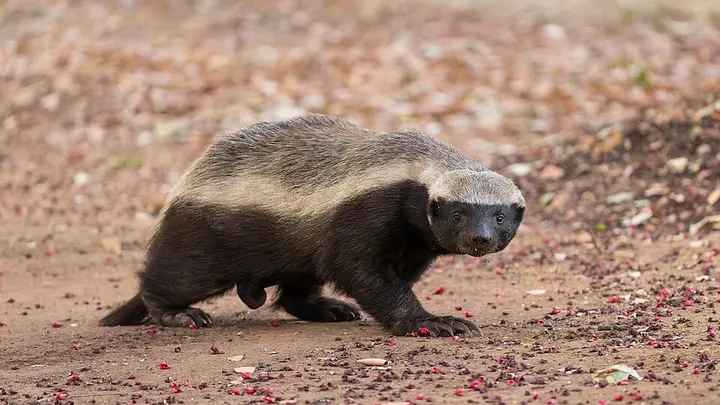
The honey badger, also known as the ratel, is a mammal widely distributed across Africa, Southwest Asia, and the Indian subcontinent. It is the sole living representative of the Mellivorinae subfamily of the Mustelidae.
It has a fairly long body, with a distinctly thick-set and broad back, and remarkably loose skin, allowing the badger to turn and twist freely within it. The largest terrestrial mustelid in Africa, the honey badger measures 55 to 77 cm (22 to 30 in) long and weighs up to 16 kg (35 lb). Sexual dimorphism has been recorded in this species, with males being larger and heavier than females. It has two pairs of mammae, and an eversible anal pouch. The honey badger is a solitary animal that can be active at any time of day, depending on the location. It is primarily a carnivorous species and has few natural predators because of its thick skin, strength and ferocious defensive abilities. Adults maintain large home ranges, and display scent-marking behavior.
Appearance
The honey badger has a fairly long body but is distinctly thick-set and broad across the back. Its skin is remarkably loose, and allows the animal to turn and twist freely within it. The skin around the neck is 6 mm (0.24 in) thick, an adaptation to fighting conspecifics. The head is small and flat, with a short muzzle. The eyes are small, and the ears are little more than ridges on the skin, another possible adaptation to avoiding damage while fighting.
Behaviour
The honey badger is mostly solitary but has been seen in Africa hunting in pairs. It also uses old burrows of aardvark, warthog and termite mounds. In the Serengeti National Park, the activity levels of the honey badger was largely dependent on the time of year; in the dry season, it was mostly nocturnal, in contrast to the wet season, when it remained active throughout the day, reaching its zenith during crepuscular hours.
Diet
The honey badger has the least specialised diet of the weasel family next to the wolverine. It accesses a large part of its food by digging it out of burrows and feeds on insects, frogs, tortoises, turtles, lizards, rodents, snakes, birds and eggs. It also eats berries, roots and bulbs. It often raids beehives in search of both bee larvae and honey. It devours all parts of its prey, including skin, hair, feathers, flesh and bones, holding its food down with its forepaws.
Habitat
The honey badger ranges through most of sub-Saharan Africa, from the Western Cape, South Africa, to southern Morocco and southwestern Algeria and outside Africa through Arabia, Iran, and Western Asia to Turkmenistan and the Indian Peninsula. It is known to range from sea level to as much as 2,600 m (8,500 ft) in the Moroccan High Atlas and 4,000 m (13,000 ft) in Ethiopia's Bale Mountains.
Where the Honey badger lives
Recorded in South Africa, Kenya, Namibia, Botswana, Angola, Benin, Zambia, Tanzania and Israel (Africa and Asia).
Most records fall in Western Cape, Mpumalanga, Limpopo, Coast, Oshikoto and North-West.
See the Honey badger’s range on the globe
Conservation status
Least concern (LC). Not at risk: it is doing well in the wild. Categories are the IUCN Red List as republished by GBIF.
Sources
The range is a density of 1,831 georeferenced GBIF records, shown on the continents where it is mainly recorded, not an expert-drawn map. Description from Wikipedia.