Animals / Mammal
Hippopotamus
Hippopotamus amphibius · Hippopotamidae
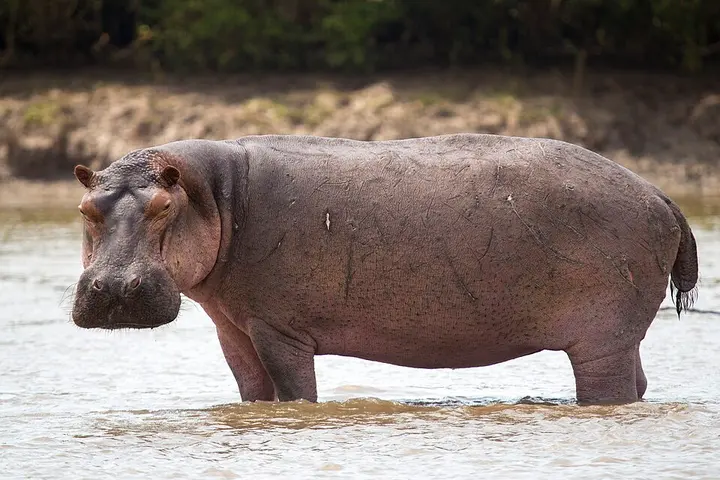
The hippopotamus, often shortened to hippo, further qualified as the common hippopotamus, Nile hippopotamus and river hippopotamus, is a large semiaquatic mammal native to sub-Saharan Africa. It is one of only two extant species in the family Hippopotamidae, the other being the pygmy hippopotamus. Its name comes from the Ancient Greek for "river horse" (ἱπποπόταμος).
After elephants and rhinoceroses, the hippopotamus is the next largest land mammal. It is also the largest extant land artiodactyl. Despite their physical resemblance to pigs and other terrestrial even-toed ungulates, the closest living relatives of the hippopotamids are cetaceans (whales, dolphins, porpoises, etc.), from which they diverged about 55 million years ago. Hippos are recognisable for their barrel-shaped torsos, wide-opening mouths with large canine tusks, nearly hairless bodies, short legs, and large size: adults average 1.5 t (1.7 short tons) for bulls (males) and 1.3 t (1.4 short tons) for cows (females). Hippos inhabit rivers, lakes, and mangrove swamps. Territorial bulls each preside over a stretch of water and a group of five to thirty cows and calves.
Appearance
The hippopotamus is a megaherbivore and is the third-largest land mammal after elephants and some rhinoceros species. The mean adult weight is around 1.48 t (1.63 short tons) for bulls and 1.365 t (1.505 short tons) for cows. Exceptionally large males have been recorded reaching 2.66 t (2.93 short tons). Male hippos appear to continue growing throughout their lives, while females reach maximum weight at around age 25.
Behaviour
Hippos are semiaquatic and require enough water to immerse in, while being close to grass. They mostly live in freshwater habitat, but can be found in estuaries. They prefer relatively still waters with gently sloping shores, though male hippos may also be found in very small numbers in more rapid waters with rocky slopes.
Life cycle
Cows reach sexual maturity at five to six years of age and have a gestation period of eight months. A study of endocrine systems revealed cows may begin puberty at as early as three or four years. Bulls reach maturity at around 7.5 years. Both conceptions and births are highest during the wet season. Male hippos always have mobile spermatozoa and can breed year-round. After becoming pregnant, a female hippo will typically not begin ovulation again for 17 months.
Where the Hippopotamus lives
Recorded in South Africa, Kenya, Tanzania, Botswana, Uganda, Zambia, Namibia, Zimbabwe and Benin (Africa).
Most records fall in Mpumalanga, Rift Valley, North-West, KwaZulu-Natal, Limpopo and Arusha.
See the Hippopotamus’s range on the globe
Conservation status
Vulnerable (VU). At risk: it could become endangered. Categories are the IUCN Red List as republished by GBIF.
Sources
The range is a density of 13,404 georeferenced GBIF records, shown on the continents where it is mainly recorded, not an expert-drawn map. Description from Wikipedia.