Animals / Mammal
Hartebeest
Alcelaphus buselaphus · Bovidae
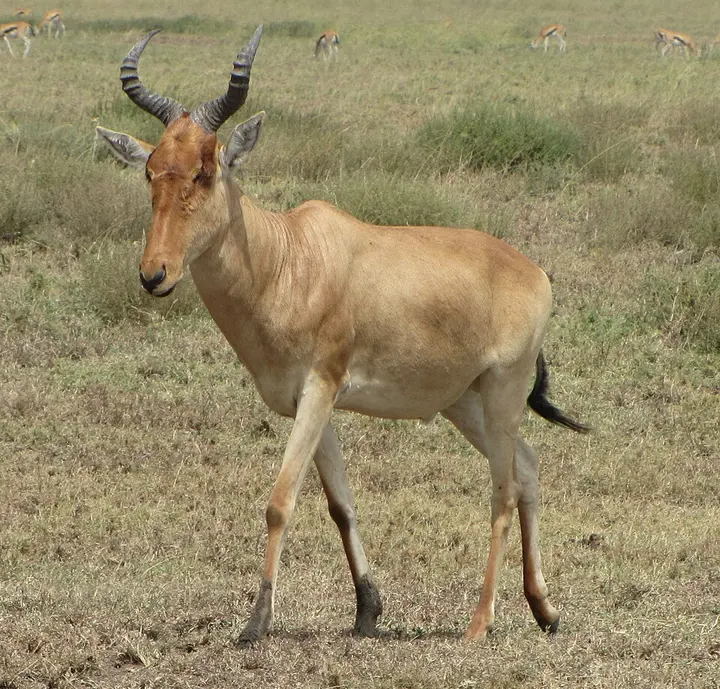
The hartebeest, also known as kongoni or kaama, is an African antelope. It is the only member of the genus Alcelaphus. Eight subspecies have been described, including two sometimes considered to be independent species.
A large antelope, the hartebeest stands just over 1 m (3 ft 3 in) at the shoulder, and has a typical head-and-body length of 2 to 2.50 m (6 ft 7 in to 8 ft 2 in). The weight ranges from 100 to 200 kg (220 to 440 lb). It has a particularly elongated forehead and oddly-shaped horns, a short neck, and pointed ears. Its legs, which often have black markings, are unusually long. The coat is generally short and shiny. Coat colour varies by the subspecies, from the sandy brown of the western hartebeest to the chocolate brown of the Swayne's hartebeest. Both sexes of all subspecies have horns, with those of females being slenderer. Horns can reach lengths of 45–70 cm (18–28 in).
Appearance
A large antelope with a particularly elongated forehead and oddly shaped horns, the hartebeest stands just over 1 m (3 ft 3 in) at the shoulder, and has a typical head-and-body length of 2 to 2.5 m (6 ft 7 in to 8 ft 2 in). The weight ranges from 100 to 200 kg (220 to 440 lb). The tail, 40 to 60 cm (16 to 24 in) long, ends in a black tuft. The other distinctive features of the hartebeest are its long legs (often with black markings), short neck, and pointed ears.
Behaviour
Active mainly during daytime, the hartebeest grazes in the early morning and late afternoon, and rests in shade around noon. Gregarious, the species forms herds of up to 300 individuals. Larger numbers gather in places with abundant grass. In 1963, a congregation of 10,000 animals was recorded on the plains near Sekoma Pan in Botswana. However, moving herds are not so cohesive, and tend to disperse frequently.
Diet
Hartebeest are primarily grazers, and their diets consist mostly of grasses. A study in the Nazinga Game Ranch in Burkina Faso found that the hartebeest's skull structure eased the acquisition and chewing of highly fibrous foods. The hartebeest has much lower food intake than the other members of Alcelaphini. The long thin muzzle of the hartebeest assists in feeding on leaf blades of short grasses and nibbling off leaf sheaths from grass stems.
Habitat
Hartebeest inhabit dry savannas, open plains and wooded grasslands, often moving into more arid places after rainfall. They are more tolerant of wooded areas than other Alcelaphini, and are often found on the edge of woodlands. They have been reported from altitudes on Mount Kenya up to 4,000 m (13,000 ft). The red hartebeest is known to move across large areas, and females roam home ranges of over 1,000 km2 (390 sq mi), with male territories 200 km2 (77 sq mi) in size.
Where the Hartebeest lives
Recorded in Kenya, Benin, Tanzania, Uganda, South Africa, Zambia and Namibia (Africa).
Most records fall in Atakora, Rift Valley, Alibori, Mara, Nairobi and Coast.
See the Hartebeest’s range on the globe
Conservation status
Least concern (LC). Not at risk: it is doing well in the wild. Categories are the IUCN Red List as republished by GBIF.
Sources
The range is a density of 4,237 georeferenced GBIF records, shown on the continents where it is mainly recorded, not an expert-drawn map. Description from Wikipedia.