Animals / Bird
Harpy eagle
Harpia harpyja · Accipitridae
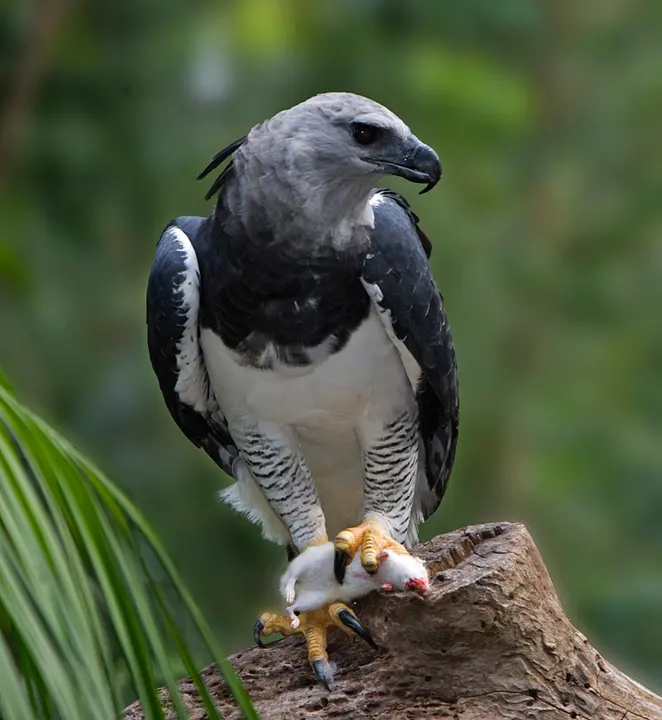
The harpy eagle is a large neotropical species of eagle. It is also called the American harpy eagle to distinguish it from the Papuan eagle, which is sometimes known as the New Guinea harpy eagle or Papuan harpy eagle. It is the largest bird of prey throughout its range, and among the largest extant species of eagles in the world.
It usually inhabits tropical lowland rainforests in the upper (emergent) canopy layer. Destruction of its natural habitat has caused it to vanish from many parts of its former range, and it is nearly extirpated from much of Central America. It is the only member of the genus Harpia, which, together with Harpyopsis, Macheiramphus and Morphnus, forms the subfamily Harpiinae.
Appearance
The upperside of the harpy eagle is covered with slate-black feathers, and the underside is mostly white, except for the feathered tarsi, which are striped black. A broad black band across the upper breast separates the gray head from the white belly. The head is pale grey, and is crowned with a double crest. The upperside of the tail is black with three gray bands, while the underside of it is black with three white bands.
Behaviour
This species is largely silent away from the nest. There, the adults give a penetrating, weak, melancholy scream, with the incubating males' call described as "whispy screaming or wailing". The females' calls while incubating are similar, but are lower-pitched. While approaching the nest with food, the male calls out "rapid chirps, goose-like calls, and occasional sharp screams".
Diet
Full grown harpy eagles are at the top of a food chain. They possess the largest talons of any living eagle and have been recorded as carrying prey weighing up to roughly half of their own body weight. This allows them to snatch from tree branches live sloths and other large prey items. Most commonly, harpy eagles use perch hunting, in which they scan for prey activity while briefly perched between short flights from tree to tree.
Life cycle
In ideal habitats, nests would be fairly close together. In some parts of Panama and Guyana, active nests were located 3 km (1.9 mi) away from one another, while they are within 5 km (3.1 mi) of each other in Venezuela. In Peru, the average distance between nests was 7.4 km (4.6 mi) and the average area occupied by each breeding pairs was estimated at 4,300 ha (11,000 acres). In less ideal areas, with fragmented forest, breeding territories were estimated at 25 km (16 mi).
Where the Harpy eagle lives
Recorded in Panama, Brazil, Ecuador, Colombia, Peru, Guyana and Venezuela (North America and South America).
Most records fall in Darién, Mato Grosso, Madre de Dios, Amazonas, Orellana and Sucumbios.
See the Harpy eagle’s range on the globe
Conservation status
Vulnerable (VU). At risk: it could become endangered. Categories are the IUCN Red List as republished by GBIF.
Sources
The range is a density of 7,592 georeferenced GBIF records, shown on the continents where it is mainly recorded, not an expert-drawn map. Description from Wikipedia.